
A final-year project usually ends on a slide in a presentation. At CMR University’s Makerspace, it ends as something you can actually hold in your hand.
From blueprint to building
Most engineering degrees teach students how to design a solution on paper, but only a few teach them how to experiment with it and build one. That gap is exactly what CMR University’s Makerspace was created to fill. Located at the Bagalur Campus, it functions as the prototyping stage of the University’s Design Thinking process. At this point, an idea stops being a concept and moves to be tested in the real world.
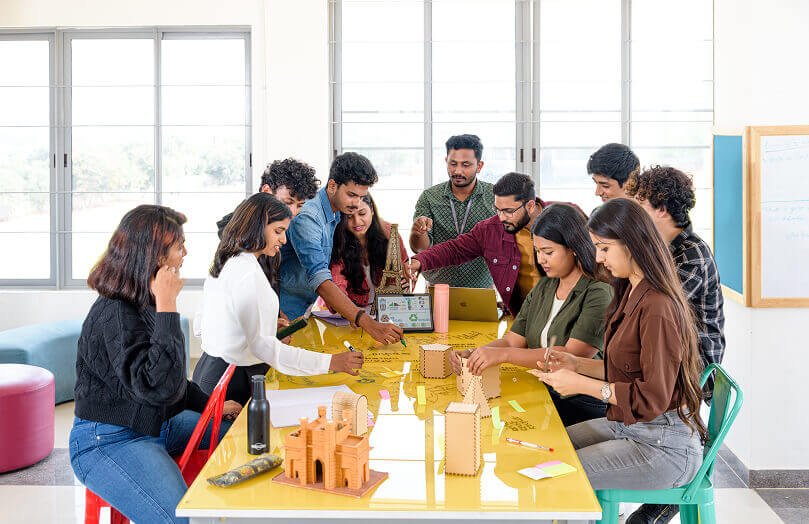
Students walk in with a design brief, a sketch or sometimes just a drafted idea and walk out with a working model. It is supported by expert faculty along with lab assistants who guide first-time users through the equipment before they begin working independently. It is less a facility that students visit occasionally and more of a space woven directly into final-year projects that instils confidence through hands-on experimentation.
The tools that shape ideas into prototypes
What makes this possible is the range of industry-grade equipment available in the space. The CNC router, one of the most frequently used machines, cuts and engraves wood for structural and design-based projects. A 3D scanner can capture a physical object and convert it into a digital file, ready to be reproduced as an exact-scale replica. On the printing side, students have access to both open FDM printers, capable of handling multiple filaments at once, and enclosed printers designed for high-temperature materials such as ABS, as well as SLA resin printers that produce the fine, intricate detail often required in applications such as jewellery design.
For projects, the lab houses a CO₂ laser cutter for acrylic, MDF and plywood, a metal lathe for shaping metal components and a comprehensive set of handheld and manual tools. From spanners and clamps to mallets and wrenches, these tools support the physical assembly work that prototyping inevitably involves. Even leftover material can be put to use. A filament shredder processes broken or unused 3D prints back into reusable material, helping make the prototyping cycle more sustainable and reducing material waste. CMR University’s Makerspace fosters teamwork and leadership skills, sharpening their foundation in STEM subjects and exposing them to future technologies alongside. Consequently, our Makerspace in Bengaluru helps budding entrepreneurs bring their vision to life, where their textbook learning builds up through interactive and enjoyable practicals.
From classroom project to real-life product
One of the most visible examples is a solar and battery-powered scooty, with its parts procured from outside but an entire frame is conceived, built and assembled inside the Makerspace by a team of 30 CMR University students. It is the kind of project that would be difficult to imagine completing without access to serious fabrication equipment on campus. Apparently, the results speak for themselves more clearly than a brochure can.
Smaller but equally telling examples come from coursework itself. Third-semester students have used the 3D printers to develop packaging design projects, while fourth-semester students have relied on the CNC machine to bring their own product concepts to life. These are not simulations or purely theoretical exercises but are functional prototypes built by students who are still years away from graduation, using the same category of tools that they will eventually encounter in real-world product development roles.
This is where the phrase ‘market-ready’ begins to appear. A student who has already scanned an object, redesigned it, printed it, tested its tolerances and rebuilt it after failure has effectively experienced a compressed version of the real product development cycle well before applying for a job that demands precisely that kind of practical experience. Hence, CMR University’s Makerspace promotes a learning model that allows learners to study by doing, rather than just memorising curriculum concepts.
Why this space matters beyond the classroom
CMR University believes the future belongs to creators, problem-solvers, and innovators. Hence, our Makerspace in Bangalore is beyond the coursework or curriculum. CMRU regularly hosts innovation showcases, workshops and expert talks that connect students with industry practitioners, allowing their prototypes to be seen and discussed beyond academic evaluation.
Above all, CMR University’s Makerspace is not restricted to students of the engineering community alone. Our lab is a cross-disciplinary design research space for collaborative project-making, open to students across design, architecture, media, business or even external users and emerging innovators who are looking to prototype an idea before transforming it into a technology venture.
That combination matters for an engineering student. A final-year project that exists only as a report or simulation can struggle when it faces the questions from real hiring managers. A final-year project that exists as an operational, tested prototype, built in the same space where real-world startups are testing their own products, tells a unique story.
That is the gap for which CMR University’s Makerspace is built to fill up – one prototype at a time.
FAQs
1. What is an engineering makerspace?
An engineering makerspace is a hands-on facility where students can design, build, test and improve physical prototypes. Unlike a conventional classroom, a makerspace gives learners access to fabrication tools, digital equipment and expert guidance so they can turn engineering concepts into working models and practical products.
2. How does CMR University’s Makerspace help engineering students?
CMR University’s Makerspace helps engineering students move from a project idea or design sketch to a tested prototype. Students can experiment with tools such as 3D printers, CNC equipment, laser cutters and scanners while developing practical skills in design thinking, fabrication, teamwork, problem-solving and product development.
3. Can final-year engineering projects become real products?
Yes. A well-planned final-year engineering project can become a functional prototype or an early-stage product when students test the design, learn from failures and improve its performance. Access to prototyping equipment and faculty mentoring can make the journey from a classroom project to a market-ready solution more realistic.
4. What equipment is available in an engineering makerspace?
A modern engineering makerspace may include 3D printers, CNC routers, 3D scanners, laser cutters, metal lathes and manual tools. These machines support different stages of product prototyping, including digital modelling, cutting, shaping, printing, assembly, testing and redesign.
5. Why is hands-on learning important for engineering students?
Hands-on learning helps engineering students understand how ideas work outside textbooks and simulations. By building and testing prototypes, students develop practical judgement, technical confidence, communication skills and the ability to solve unexpected problems, qualities that employers value in product development and engineering roles.
6. Can students from non-engineering courses use a makerspace?
Many university makerspaces are designed for cross-disciplinary collaboration. Students from design, architecture, media, business and other programmes can contribute ideas, user research, visual design, business planning or communication skills to product projects, depending on the facility’s access policy and project requirements.
7. How can an engineering prototype improve a student’s resume?
A working engineering prototype gives students more than a project title to discuss during interviews. It allows them to demonstrate how they identified a problem, designed a solution, selected materials, handled testing, improved the product and worked with a team to deliver a practical outcome.
8. What skills can students develop through product prototyping?
Product prototyping can build skills in 3D modelling, fabrication, design thinking, testing, documentation and project management. Students also strengthen soft skills such as teamwork, leadership, communication, creativity, adaptability and problem-solving while working through the product development cycle.