Scope & objectives
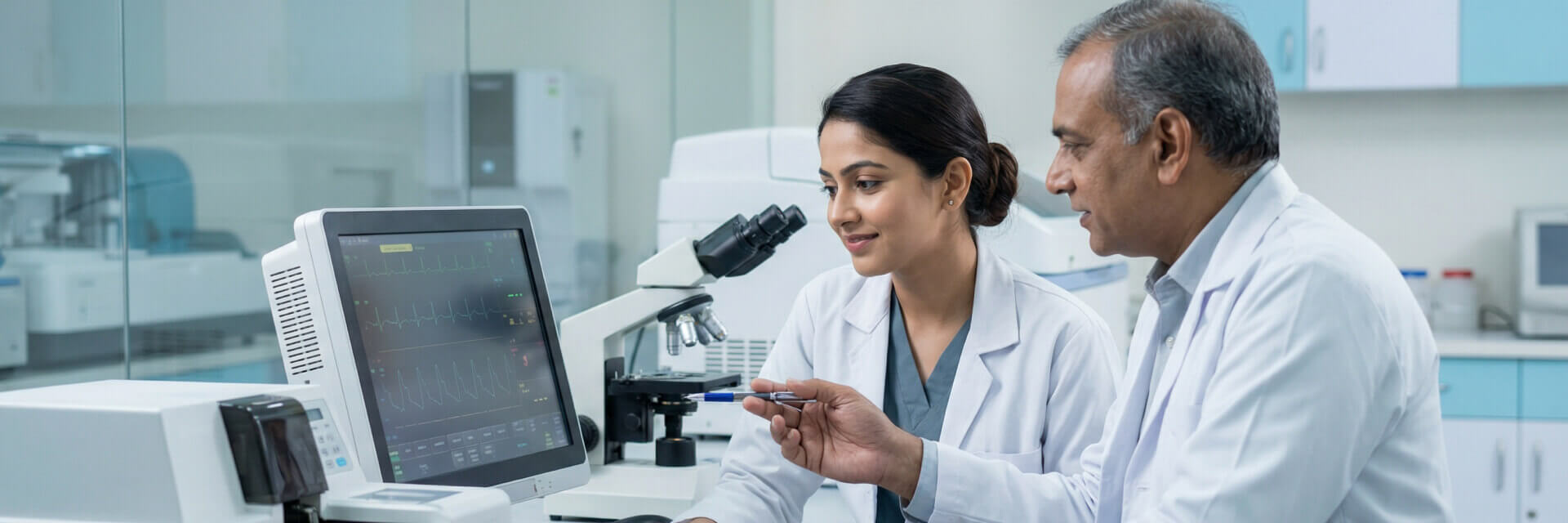
- The programme equips students with advanced training in modern imaging technologies, including ultrasound, fluoroscopy, CT, and MRI.
- Emphasis is placed on equipment handling, quality assurance, radiation safety, and patient care.
- Learners develop competence to assist radiologists and healthcare teams in delivering precise diagnostic services.
- Graduates can pursue roles in hospitals, tele-radiology centres, research laboratories, and specialised imaging facilities.
Programme structure
The syllabus is organised semester-wise, covering medical imaging principles, radiographic techniques, and image analysis. Students progress towards advanced diagnostic procedures and imaging protocols.
Semester I
- Medical Terminology
- Anatomy and Physiology
- Introduction to Radiology Technology
- Vital Signs
- Management of Medical Emergencies
- Basic Physics
- Health Care Delivery System
- Basic Concept of Health and Hospital
Semester II
- Infection Control and Biomedical Waste Management
- X-Rays Production
- Radiographic Patient Positioning
- Contrast Media
- Conventional & Digital Radiography
- Interventional Radiology Procedures
- Barium Enema
- Radiation Hazards, Prevention and Safety
- Patient Care in Radiology
- Patient Communication
- Hospital Services
Semester III
- Specialised Radiographic Techniques
- Basics of Computed Tomography (CT)
- Basics of Magnetic Resonance Imaging (MRI)
- Documentation and Records
- Quality Assurance in Radiology
- Medical Law and Ethics
- Sales and Marketing
- Positioning and Procedures for CT and MRI
- Basics of Ultrasonography (USG)
Semester IV
- Equipment Management in Radiology
- Modern Imaging Techniques and Recent Trends in Imaging
- Pharmacology
- Basic Radiology Diagnosis and Report analysis
- Advanced Procedures in CT and MRI
- Radiation Therapy
Programme Assessment
1. Continuous & Comprehensive Evaluation (CCE)
CMRU emphasises learning by doing, with assessments built around practical activities, team projects, design thinking, and case studies. The CCE framework supports continuous assessment of students in both academic and soft-skill domains.
2. Internal Quality Assurance Cell (IQAC)
The IQAC ensures credibility and consistency across evaluation mechanisms. It oversees assessment processes, modern pedagogical tools, and supports continuous improvement in academic delivery.
3. Student Portal & Transparency
Students have access to a dedicated Student Portal where attendance, CCE marks, and Internal Assessment Test (IAT) scores are updated and viewable in real time.
4. Fieldwork, Projects & Internships
University programmes are designed to include field projects, research components, and internships as part of their evaluation especially in disciplines where practical skills are necessary.
5. Feedback-Driven Iteration
CMRU routinely collects structured feedback from students, alumni, faculty, employers, and academic peers using it to refine both curriculum and assessment strategies.
Programme outcomes
Graduates will learn to:
- Demonstrate understanding of anatomy, radiology fundamentals, and basic physics in imaging.
- Apply skills in X-ray, CT, MRI, ultrasound, and digital radiography techniques.
- Manage medical emergencies in radiology settings and assist in interventional radiology.
- Adhere to medical protocols, patient care ethics, and effective communication.
- Ensure radiation safety, quality assurance, and accurate diagnostic imaging through advanced positioning techniques.