







A national survey. Three rankings. One clear signal: legal education at CMR University is moving in the right direction.
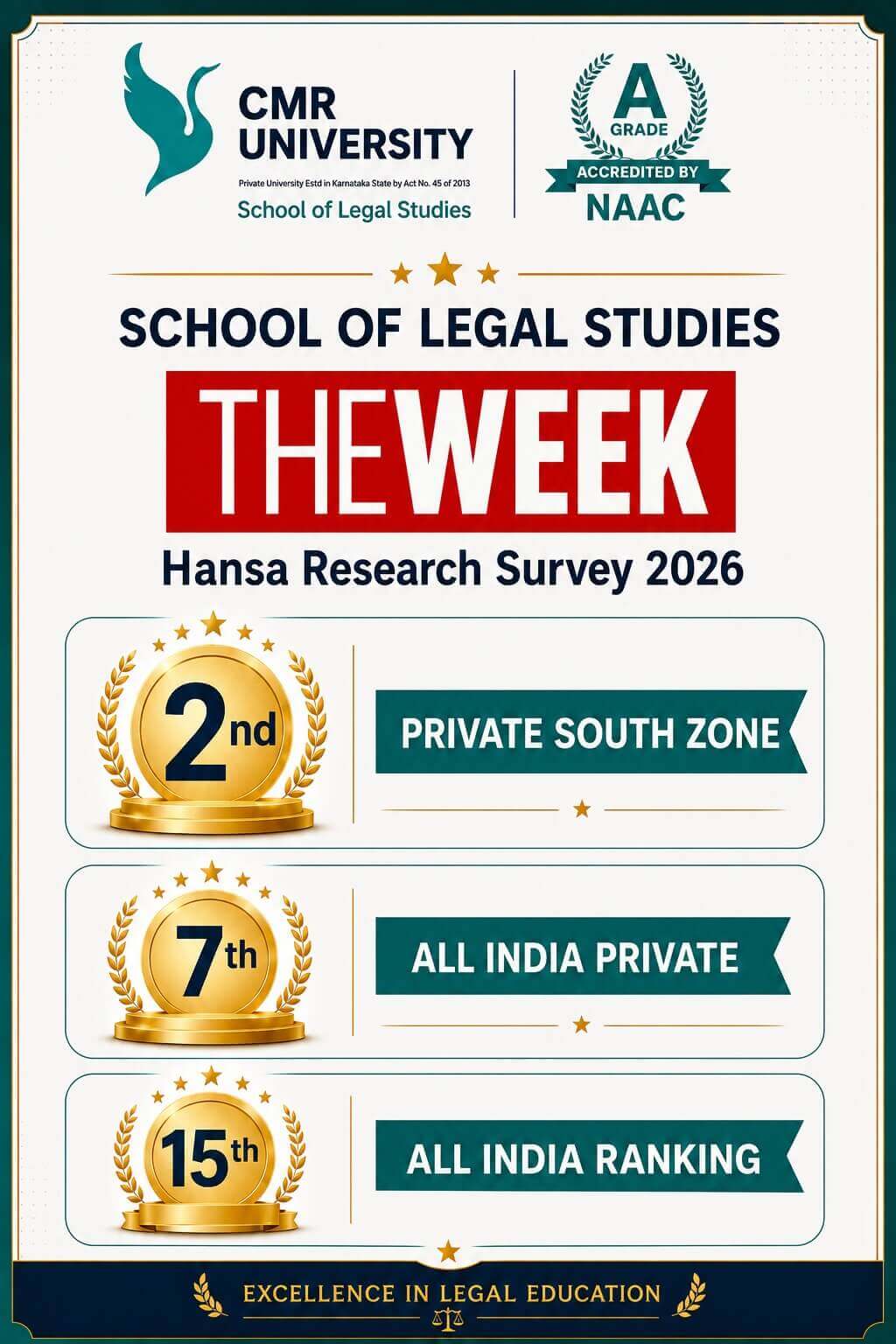
CMR University’s School of Legal Studies has been ranked 2nd among private law colleges in the South Zone, 7th among all private law colleges across India and 15th in the All India Rankings by The Week Hansa Research Survey 2026.
The ranking reflects what has been building steadily at the School of Legal Studies: a rigorous academic environment, a faculty committed to research and practice and a student community being prepared for a legal profession that is changing faster than most people realise.
CMR University was founded on a belief that every person can achieve their potential if given access to a well-rounded education. That belief shapes how the School of Legal Studies approaches legal training: not as a set of statutes to be memorised but as a discipline that demands critical thinking, ethical judgment and the ability to navigate complexity. It is this orientation towards producing graduates who are both professionally competent and socially conscious that independent surveys such as this one are just beginning to recognise.
Legal analyst is now one of the fastest-growing roles in Bengaluru’s job market in 2026, with companies across technology, fintech and consulting actively hiring law graduates who can navigate regulatory complexity, manage contracts and support strategic decision-making. A ranking of this nature signals to those employers that graduates from this school arrive prepared.
The School of Legal Studies at CMR University is NAAC ‘A’ Grade accredited and offers programmes designed to integrate doctrinal rigour with practical exposure. Moot courts, legal aid clinics, internships and industry interface are embedded into the student experience, not added as afterthoughts. This sits squarely within CMR University’s broader mission: to create leaders for a knowledge-based economy who carry both the technical depth and the ethical grounding that the profession demands.
This recognition from The Week Hansa Research Survey 2026 is an independent validation of that commitment. It places CMR University’s School of Legal Studies firmly among the institutions shaping the future of legal education in India.
FAQs
1. What are the admission requirements for top private law colleges in India?
Most private law colleges require a minimum aggregate of 45% in 12th grade (with relaxation for reserved categories), plus a qualifying entrance score commonly CLAT, LSAT, or the university’s own admission test. CMR University follows this pattern: 45% (General) / 42% (OBC) / 40% (SC/ST), with admission open via CLAT, LSAT, or CMRUAT. Check CMR University’s law admission requirements.
2. Which private college is best for an LLB in Bangalore?
The right choice depends on whether you need the 3-year LLB (for graduates) or a 5-year integrated LLB (after 12th), along with faculty strength, moot court exposure, and placement support. CMR University’s School of Legal Studies offers both paths in Bangalore, with flexible admission that doesn’t require a CLAT score. Explore CMR University’s law programmes.
3. Which is better a 5-year integrated LLB or a 3-year LLB?
It depends on where you are: a 5-year integrated LLB (B.A. LLB or BBA LLB) suits students straight out of 12th who want to combine a base degree with law from the start. A 3-year LLB suits graduates who already hold a bachelor’s degree and want to add a law qualification. CMR University offers both, so students can choose based on their current stage rather than being forced into one path. Compare CMR University’s LLB programmes.
4. Is an LLB degree difficult or easy to complete?
It’s manageable with consistent effort rather than inherently “hard”. LLB involves heavy reading, understanding statutes and case law, and regular internal assessments. Students who stay consistent with coursework and enjoy analytical reasoning tend to find it very doable; those expecting a light course load are often caught off guard by the reading volume.
5. What is the CLAT exam, and what is it used for?
CLAT (Common Law Admission Test) is India’s national entrance exam for admission to the National Law Universities (NLUs) and many other law schools. It tests legal reasoning, reading comprehension, logical reasoning, general knowledge, and quantitative aptitude, and is used for both 5-year integrated LLB and LLM admissions.
6. Can I become a lawyer without taking the CLAT exam?
Yes, CLAT isn’t the only route into a law degree. Many universities accept alternative entrance scores or conduct their own admission test. CMR University, for example, offers admission to its B.A. LLB, BBA LLB, and LLB programmes without requiring CLAT accepting LSAT or CMRUAT instead. Apply to CMR University’s law programmes without CLAT.