
“Schools belong to the neighbourhoods, but universities belong to the country.”
— Shri. Jayadeep K R Reddy
“Our Institution recognises that each generation of students carries different expectations, attitudes and learning requirements,” Shri. Jayadeep K R Reddy, CEO of CMR Group of Institutions (CMRGI) and Pro-Chancellor of CMR University (CMRU), emphasises in his podcast interview with The Times of India. He highlights how universities play a major role in contributing to the future of the country, especially now that they have greater autonomy in designing their academic curricula. Higher education institutions are responsible for shaping, teaching and empowering young minds, preparing students to become the future builders, leaders, innovators, researchers and governors who will contribute to developing our country.
He continued to explain how he views universities as a miniature version of society, where people from different backgrounds, areas of expertise and professions interact and collaborate. The best ideas emerge when students with distinct perspectives, knowledge and skills across varied disciplines come together to exchange ideas and combine strengths. To make this possible, CMR follows a Choice Based Credit System (CBCS), offering students the flexibility to explore multiple academic disciplines through electives and MOOC courses. It also encourages interdisciplinary learning, allowing students to interact with peers from different academic backgrounds, exchange ideas and collaborate on projects. This is where CMR’s approach to Design Thinking comes to life through six core phases, each reflected in the learning experiences, opportunities and initiatives the institution offers: Empathise, Define, Ideate, Prototype, Test and Implement.
Watch the full interview with Shri. Jayadeep K R Reddy featured by The Times of India
CMR’s journey: From seven to 22,000+ students
CMR’s humble journey began in the early 1990s, when Dr. Sabitha Ramamurthy, Chancellor of CMR University, saw the lack of quality education in her own neighbourhood. Rather than merely advocating for change, she took concrete steps towards creating it. “It started in a shed with just seven students; we now educate and nurture over 22,000+ aspiring young changemakers of the country with an educational ecosystem that now spans from pre-school to PhD. Since its inception, Dr. Sabitha Ramamurthy has continued to provide academic leadership as President of the Trust and Chancellor of CMR University. With an unwavering eye for the future, CMR University consistently evolves based on the changing needs of society and the diverse requirements of the new generation of learners in this rapidly progressing world,” he said.
Why Design Thinking is central to our educational philosophy
While AI is on the rise and has brought significant changes to the working world, Shri. Jayadeep K R Reddy explains in his podcast interview how AI should reinforce human work rather than replace the need to develop fundamental skills.
The most successful people today are those who possess strong domain knowledge, stay up to date and use AI to enhance their efficiency. AI can be accessed by all, but what differentiates us is how well we understand our domain and how effectively we use technology.
This is why CMR incorporates AI modules across its programmes and courses while strengthening the core skills students need for long-term success. CMR actively incorporates Design Thinking into teaching and learning so that problem-solving is not limited to students studying design, he highlighted. This approach enables students across disciplines, including computer science, to apply their knowledge and skills to real-world challenges.
Have you heard the quote: “Winners don’t do different things, they do things differently?”
Everyone can teach and tell you what to think, but no one tells you how to think. Design Thinking is not just about design and creativity; it is about finding creative solutions through reasoning. Incorporating Design Thinking into regular learning transforms the way students think, question, solve problems and perceive the world. It moves education beyond memorising information, preparing students to become curious thinkers, confident problem-solvers and empathetic individuals.
We believe every field needs people who can think critically, identify problems and explore different possibilities to find practical solutions. It also needs people who understand human needs. By developing critical thinking skills and communication skills, Design Thinking enables students to approach challenges with confidence rather than feel intimidated by them.
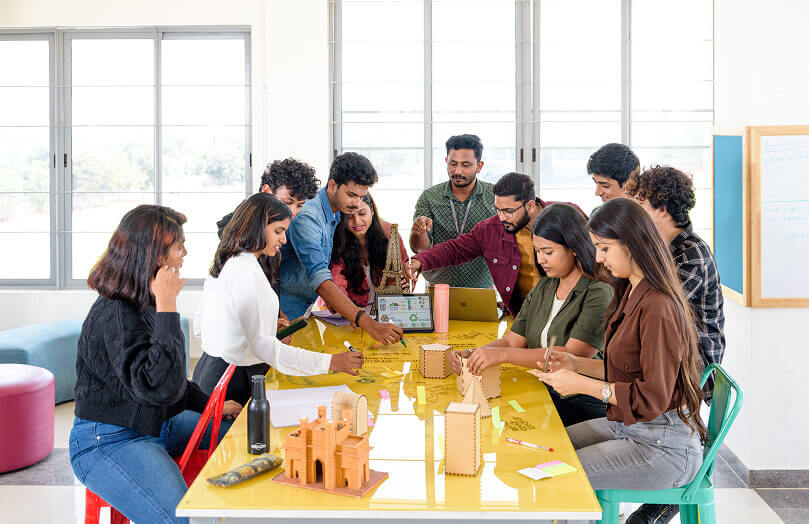
Our Design Thinking philosophy extends to the way students are evaluated as well. Nearly 50% of a student’s evaluation is based on projects and project-based learning. Students are encouraged to research, empathise with the people they are solving problems for, develop prototypes, experiment with ideas and refine their solutions. This experiential learning approach allows students to apply classroom concepts, gain a deeper understanding of real-world problems and improve their ability to develop practical solutions.
Design Thinking encourages students to look beyond existing solutions and understand unmet needs. It helps them approach challenges from different perspectives and explore how an idea can become a business. Case studies and practical projects further strengthen this process by encouraging students to analyse problems, evaluate possible solutions and apply their learning in real-world situations.
CMR’s entrepreneurial ecosystem gives students the chance to put Design Thinking into action; they do not have to wait until graduation to explore entrepreneurship. Even students in their second year who have promising ideas can access incubation support, infrastructure, funding, human capital, domain expertise and the Makerspace. These opportunities encourage student work that goes beyond theory, supporting skill development and enabling students to turn ideas into practical solutions.
The University’s Innovation Council continues to connect entrepreneurs with teachers and professionals from different industries who can support them in developing their ideas. We provide legal assistance with patents and company registration, allowing students to learn and practise the real-world aspects of creating a company.
He also mentioned in the interview that CMR incubates at least 10 businesses every year. CMR encourages students to pursue careers beyond conventional paths. Its proposed two-lakh-foot Incubation and Innovation Centre is meant to strengthen this environment by bringing academia closer to the industry and creating more opportunities for students to apply their learning.
From identifying problems to creating opportunities
With approximately 50 student clubs spanning interests such as photography, creative writing and astronomy, students are encouraged to explore different passions, discover new interests and develop skills beyond their chosen discipline. The LEAP system further recognises and tracks their participation in extracurricular activities, making holistic development an integral part of their university journey. These experiences complement the course offerings by encouraging interdisciplinary learning, communication skills and the development of knowledge and skills beyond the classroom.
However, Design Thinking goes beyond individual development. It also involves understanding how we can create better experiences for a larger community. CMR’s sporting infrastructure, including its FIFA-Certified Football Ground and ICC-Standard Cricket Stadium, reflects its vision of creating spaces that engage not just students but also the wider city through sporting events and concerts.
This philosophy extends to our educational institutions. We incorporate sustainable practices such as zero-waste initiatives, water conservation and renewable energy. The use of a former quarry as a rainwater storage resource, with an estimated capacity of two crore litres, and the conversion of hostel food waste into fertiliser demonstrate how thoughtful planning can address real-world environmental challenges. These initiatives encourage students to develop a deeper understanding of sustainability and explore how their learning can contribute to meaningful change.
CMR’s end goal through Design Thinking is to shape individuals who are equipped to face life’s challenges, transform their learning into meaningful and mindful actions, and become catalysts for a better future and society.