
What happens when a centre rooted in indigenous craft wisdom shakes hands with a company building the future of sustainable materials? At CMR University, that question has been answered.
There is a quiet revolution happening inside the Makerspace at CMR University’s Lakeside Campus. It does not announce itself with noise or spectacle. Instead, it happens in the simple meeting of hands and ideas – like when a student holds a panel made from agricultural fibre and realises that the future of construction does not always have to come from a factory. Sometimes, it comes straight from a domain.
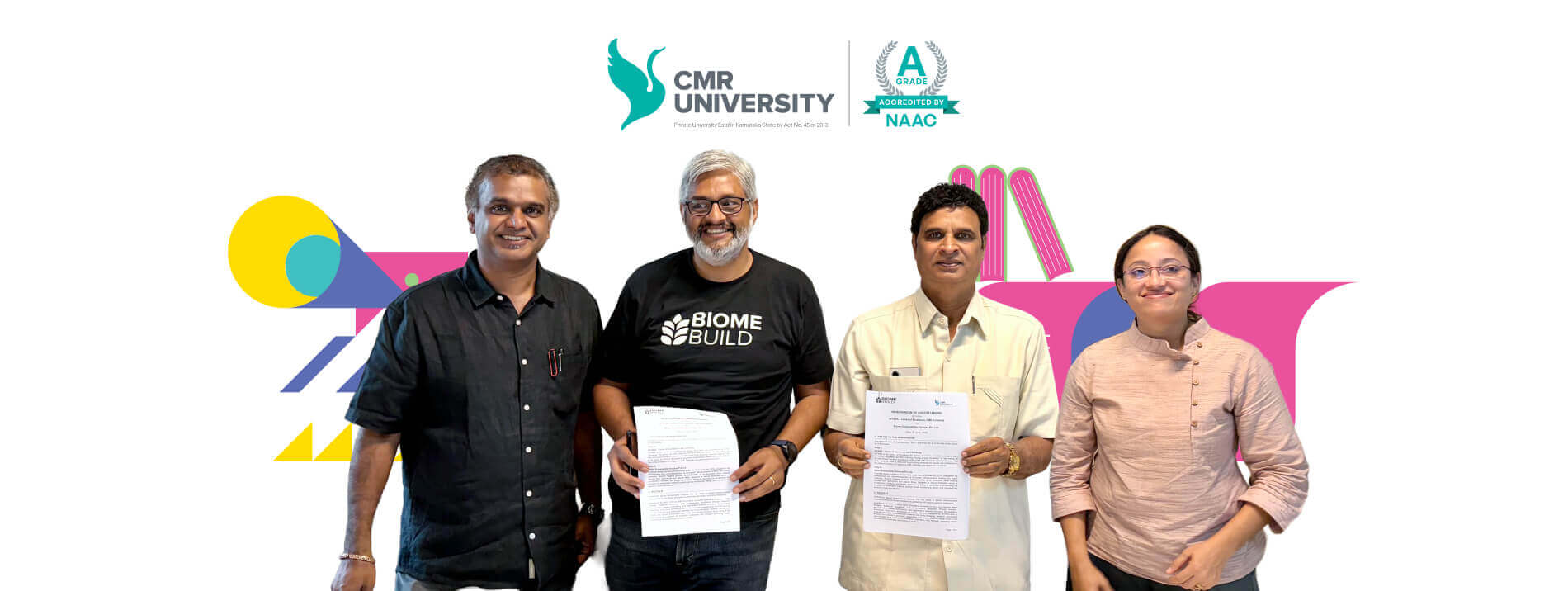
On 4 June 2026, NITARA – the Centre of Excellence at CMR University, Bengaluru – signed a Memorandum of Understanding with Biome Sustainability Ventures Pvt. Ltd., a team doing pioneering work in bio-based, climate-positive building materials. It is a partnership that feels almost inevitable, because both sides have been asking the same question from different directions: what does it mean to build responsibly, and what does the past have to teach the future?
Two organisations, one shared belief
True to its name, NITARA is a Centre of Excellence built on a firm conviction: that meaningful design education in India needs to stop treating indigenous craft traditions, local materials, and regenerative building practices as historical footnotes, and start treating them as living, breathing knowledge we can use today. The Centre was built on a firm conviction: that meaningful design education in India needs to stop treang indigenous craft traditions, local materials, and regenerative building practices as historical footnotes, and start treating them as living, breathing knowledge we can use today.
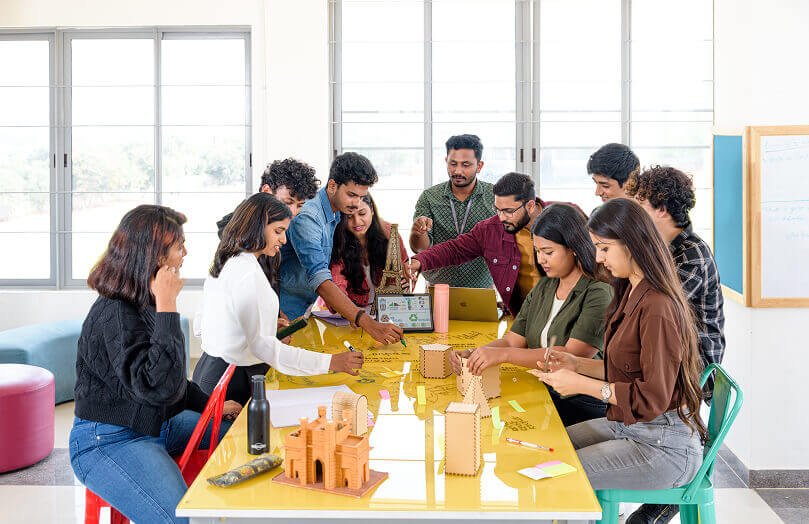
Led by Prof. Muralidhar Reddy at the School of Architecture, NITARA directly connects students with expert artisans. Here, centuries-old terracotta cooling systems, traditional lime mortar mixes, and vernacular rainwater harvesting methods are not studied as museum pieces – they are used as working principles. Students apprentice, document, build and question. The FullScale Workshop series, now in its 16th edition, gets students designing and constructing at a 1:1 scale, learning how materials actually behave under their own fingers instead of simply staring at screens.
Biome Sustainability Ventures occupies the perfect complementary space. Driven by a mission to speed up the shift towards sustainable materials in architecture and manufacturing, their flagship product, BIOMEBOARD, is a panel material made from agricultural and natural fibres, engineered to radically accelerate the embodied carbon in construction, furniture and interior design. In the most literal sense, it is a material that manifests the farm into a building site.
The alignment between the two is more than a happy accident; it’s structural.
What the partnership means in practice
Under the terms of this agreement, NITARA and Biome are collaborating across four key areas:
- Development of actual design pieces and interventions using BIOMEBOARD for furniture, interiors and architecture.
- Hands-on research into how bio-based materials perform and how to design for a truly circular economy.
- Academic and industry workshops, live projects and design studios focused on low-carbon alternatives.
- Knowledge dissemination through publications, exhibitions and public talks to help the wider world embrace sustainable material systems.
For students at CMR University’s School of Architecture, this translates into something tangible and immediate: access to a real material, developed by a real company, for use in real-world projects. BIOMEBOARD will be directly integrated into the research and teaching at NITARA, giving students a firsthand understanding of what farm-to-fibre design really feels like.
This is exactly the kind of learning NITARA was built for, not for sitting through sustainability theories, but coming into direct contact with it. It’s made more than to sit for a lecture on regenerative materials, its purpose is to hold the material in hand – for testing, questioning and building something real.
Grounding innovation in what endures
There is a constant temptation, whenever we talk about the future of design and architecture, to assume that innovation only moves towards the new, the digital, and the unprecedented. NITARA has always pushed back against that assumption, and this partnership is perhaps the clearest expression of that pushback yet.
BIOMEBOARD is undeniably a modern product – engineered, tested and ready for the construction industry of tomorrow. But the philosophy that gives it a meaning – the idea that building materials should come from the earth, return to the earth, and cause as little harm as possible in between – is not new at all. In fact, it is one of the oldest concepts in human architecture. India’s craft traditions and local building practices have been working with this exact principle for centuries.
NITARA’s role in this partnership is to hold both of these truths at once: to bring the depth of indigenous knowledge into genuine dialogue with modern material science. The purpose is to upskill designers who can bridge that divide – people who see what a traditional lime mortar can teach a modern building system, and who can look at a new bio-based panel and value its relationship to the land, the community and the climate, well beyond its technical data sheet.
As Prof. Muralidhar Reddy quoted at the ceremony:
“This MOU reflects NITARA’s core philosophy – to build deep foundations for the future by learning from the past. Partnering with Biome allows us to bring regenerative, farm-to-fibre materials like BIOMEBOARD directly into design education and innovation, bridging indigenous knowledge with climate-responsive technology.”
A step forward for regenerative design education
The partnership was formalised on behalf of NITARA by Dr Prakash KE, Registrar of CMR University, and on behalf of BIOMEBOARD by Mr Sumeet Popli, Prof. Muralidhar Reddy and Prof. Renuka Oka from NITARA were also present at the signing ceremony.
For CMR University’s School of Architecture – a programme that has already carved out a distinctive space through its FullScale workshops, a Makerspace that blends robotic fabrication with AI-assisted design and its apprenticeship model with master artisans – this partnership adds a vital new layer to what is already one of the most hands-on architecture programmes in Bengaluru.
The future of design is beyond digital. It is ecological, cultural and deeply rooted. At NITARA, that future is already being built – one material, one workshop and one student at a time.