



With its maker-centred curriculum, studio culture and hands-on learning experience, CMR University’s School of Architecture prepares students for diverse careers
You have spent years doodling buildings, rearranging spaces in your head and wondering what it would look like if that corner of your city were redesigned from scratch. Architecture chose you a long time ago. Now the question is which school deserves you.
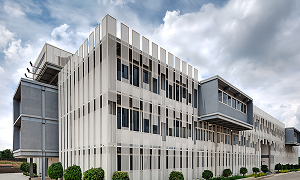
If you are a student or a parent helping your child look for B.Arch. Bangalore private college options, CMR University’s School of Architecture, is worth more than a passing look. Established in 2015 and approved by the Council of Architecture (CoA), India, it has built a clear identity in a short time: a school where what you make matters as much as what you draw and where the city of Bengaluru is as much a part of your education as the studio inside it.
Here is what you need to know about how to get in, what the experience feels like and where a degree from here can take you.
What Is the B.Arch. Programme at CMR University?
The B.Arch. course at CMR University is a full-time five-year programme housed at the Lakeside Campus on Hennur-Bagalur Road, with a fee of ₹75,000 per semester. The school’s ethos is captured in three words that its director uses as a compass: Build Less, Build Light, Build Wise.
That is more than a tagline. Students are trained to think about ecological responsibility, material efficiency and contextual design from their very first semester. The pedagogy is described as “maker-centred” where learning happens through hands-on construction, material experiments and real-scale making, not only through drawings and lectures.
The programme runs across ten semesters. Semester VII is dedicated entirely to a professional training internship with a partner firm, making real-world exposure a mandatory part of the degree. The final semester culminates in the Architectural Design Thesis, a full-scale original project that defines each student’s identity as a designer upon graduation.
Admissions and the NATA Cutoff at CMR University
The first hurdle for any aspiring architect in India is the National Aptitude Test in Architecture (NATA). Unlike standard entrance exams, NATA is designed to test whether you actually think like a designer: your observation, sense of proportion and ability to visualise space.
To be eligible for the B.Arch. programme at CMR University, candidates must meet the following criteria:
- Academic Background: Passed 10+2 with at least 45% aggregate marks, with Physics, Chemistry and Mathematics (PCM) as compulsory subjects. Alternatively, a 10+3 Diploma with Mathematics is also accepted.
- Entrance Exams: A valid NATA or JEE Main Paper 2 score is mandatory.
Regarding the NATA cutoff at CMR University, the university’s position is guided by a flexible, case-by-case approach. The primary requirement is qualifying in NATA as per CoA standards. The specific score considered competitive varies each cycle depending on the number of applicants and overall performance that year. Therefore, instead of chasing a fixed number, the focus should be on achieving the highest score possible.
For the current 2026-27 cycle, the admissions team at the Lakeside Campus will guide you through what is considered competitive. You can also apply online through the CMRU admissions portal. The K-UGCET code for B.Arch. is E245.
B.Arch. vs B.Des. : Choosing the Right Path
A question that comes up often, especially at CMR University, where both programmes sit on the same campus, is B.Arch.vs B.Des., which to choose?
There is no single answer that fits every student. But here is a useful way to think about it. The distinction is practical. B.Arch. is a five-year COA-approved programme that requires a PCM background and a valid NATA or JEE Main Paper 2 score. It trains you to design buildings and physical spaces and qualifies you to register as a licensed architect after completing a mandatory internship and passing the registration examination.
B.Des. is a four-year programme covering Communication Design, Product Design, Fashion Design and Interior Space Design. It is open to students from all academic streams and offers broader creative mobility across design disciplines without the statutory licensing framework that architecture entails.
Architecture rewards people who are genuinely curious about how spaces shape experience, how materials carry culture and how a city grows. If that curiosity is already alive in you, CMR University’s School of Architecture provides you with the right conditions to become a professional.
Therefore, if your instinct is more towards objects, visuals or user experience, B.Des. makes that room for you. If you are drawn to how spaces function, cities grow and how design shapes everyday life, then B.Arch. is your direction. Neither is the superior choice. Both serve different genuine ambitions.
Studio Culture and Learning at CMR University
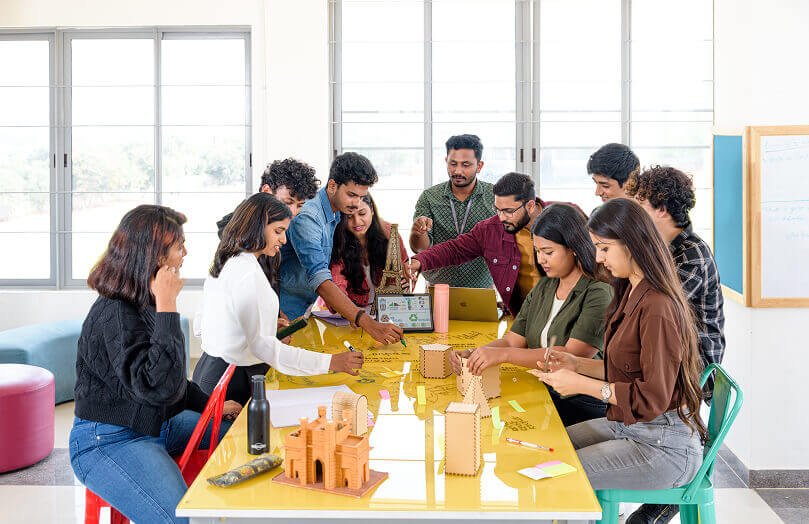
Ask any architecture graduate what they actually remember about their five years, and the answer is rarely a lecture. It is the model that fell apart at midnight, the jury where a faculty member said something that changed how you perceive a space and the workshop where you built something at full scale and for the first time, how a material actually behaves under load.
Architecture studio culture in Bangalore at CMR University is built around exactly that kind of learning. The school’s Maker Space, a dedicated hands-on facility at the Lakeside Campus, sits at the heart. Here, students work with robotic arms for precision fabrication, experiment with augmented reality for spatial visualisation, explore 3D printing with sustainable materials, including mycelium composites and engage with IoT sensors embedded in prototype structures to measure thermal performance in real time.
Sharing the same space is NITARA, the Centre of Excellence (COE) at the CMR University Lakeside Campus. The name means “having a deep foundation” or “well-rooted”, and that is precisely what it does. NITARA bridges traditional knowledge and modern design application. It researches and documents indigenous folk crafts, materials and vernacular techniques, runs design consultancy for craft clusters and NGOs, develops regenerative materials from textile and building industry waste and organises national-scale events, including the CMR National Art Camp. Through NITARA, students gain exposure to terracotta cooling systems, lime mortar formulations, vernacular rainwater-harvesting structures and indigenous joinery, all within the same Maker Space where they programme drones and run parametric models. The school is deliberate about this pairing: it wants graduates who can prototype a bamboo joint and programme a construction drone with equal comfort.
The signature event of the academic calendar is the FullScale workshop, now in its 16th edition. Every semester, students across all five years come together to design and build at a 1:1 scale. No scale models. No renderings. Actual construction. This breaks down the hierarchy between seniors and juniors and puts everyone in direct contact with the realities of material constraints, joinery, sequencing and real budgets. FullScale is also one of NITARA’s flagship programmes, which means it carries the added dimension of craft research and material intelligence alongside the making.
The CMR University Architecture Faculty is led by Director Prof. Muralidhar Krishna Reddy, a Professor and Director specialising in Industrial Design, with extensive experience across academia, design consulting and institution building. Holding an M.Des. and currently pursuing a Ph.D., he brings a practice-led, innovation-driven approach to education rooted in human-centred, sustainable and interdisciplinary design. Visiting faculty from major Indian and international firms bring current practice into the studio, while NITARA’s collaborations with professional bodies, including the IIA and IIID, build additional pathways for students to connect with the wider profession.
For cultural life, the school has three student-led events: Chingari (the annual design exhibition), Chilipili (the cultural festival) and Sangria (the sports and wellness event). Participation in events like Bangalore Design Week has connected students directly with the professional design community well before they graduate.
What also sets the school apart is how early it starts preparing students for the profession. From the first year itself, career readiness is woven into the experience through mentorship, soft skills training and modules that build professional confidence alongside design ability. The University’s Department of Common Core Curriculum (DCCC) takes this further with client presentation workshops and project management simulations that mirror real studio practice.
Across the programme duration, such exhibitions, public juries and design expos ensure students are not just learning privately but building visibility, receiving critical feedback from the industry and developing the kind of professional presence that actually gets them hired.
Architecture Career Paths in India 2025: What Comes After Five Years?
India’s construction and urban development sector is expanding at a pace that makes architecture one of the more genuinely in-demand disciplines. The government’s housing, infrastructure and smart city programmes have sustained that demand and Bangalore, one of the country’s most active design markets, sits right at the centre of it.
Private architectural practice is the most common entry point, with firms hiring fresh graduates as architectural assistants and junior designers across residential, commercial and civic projects.
Architecture jobs in Bangalore salary benchmarks currently sit at ₹3 to 5 LPA at:-
- Entry level, ₹ 8 to 12 LPA
- Mid-level and ₹ 15 LPA and above for experienced roles.
Senior architects with specialisations in sustainable design or computational architecture can earn ₹ 20 LPA and above.
Government sector roles through the CPWD, Housing and Urban Development Corporation (HUDP) and the Archaeological Survey of India (ASI) offer job security, structured growth and national-scale work. Emerging specialisations, including BIM, parametric design, AR/VR visualisation and sustainability consulting, are opening career paths that did not exist a decade ago and CMR University’s priority is to provide both digital tools and craft knowledge, placing its graduates well.
Higher studies remain a popular choice. An M.Arch. with a specialisation in urban design, sustainable architecture or heritage conservation opens doors to research, academia and international practice, making it a natural next step for students who want to go deeper into the discipline.
FAQs
- What is the eligibility for B.Arch. at CMR University?
Candidates must have passed 10+2 with Physics and Mathematics as compulsory subjects with at least 45% aggregate, along with a valid NATA or JEE Main Paper 2 score. A 10+3 Diploma with Mathematics and 45% aggregate is also accepted. - What NATA score is required for admission to CMR University’s B.Arch.?
The primary requirement is qualifying in NATA as per CoA standards. The specific score varies each cycle and is best confirmed directly with the admissions team for the current year. - Where is the School of Architecture located?
At CMR University’s Lakeside Campus on Hennur-Bagalur Road, Bengaluru. The K-UGCET code for B.Arch. is E245. - What is the fee for B.Arch. at CMR University?
It is ₹ 75,000 per semester, making the total programme approximately ₹ 7.5 lakhs over five years. - What career paths are available after B.Arch. from CMR University?
Graduates pursue careers in private practice, government departments including CPWD, urban planning, BIM and computational design, sustainability consulting, academia and international postgraduate study. - What is the difference between B.Arch. and B.Des. at CMR University?
B.Arch. is a five-year COA-approved programme leading to professional licensing as an architect. B.Des. is a four-year creative programme across Communication Design, Product Design, Fashion Design and Interior Space Design, without the statutory architecture licensing framework.
Conclusion
Choosing B.Arch. admissions at CMR University is about stepping into a discipline that demands creativity, consistency and real problem-solving. The NATA cutoff at CMR University is not a fixed number but is confirmed during the admission process based on each cycle. What matters more is how well you prepare and how clearly you understand the kind of education you are signing up for.
If you want a school where theory and making come together from day one, where your studio floor might have a full-scale construction semester and a parametric model in the next at Bengaluru’s incredible environment, then CMR University’s School of Architecture is worth a serious conversation, going beyond a drawing board.