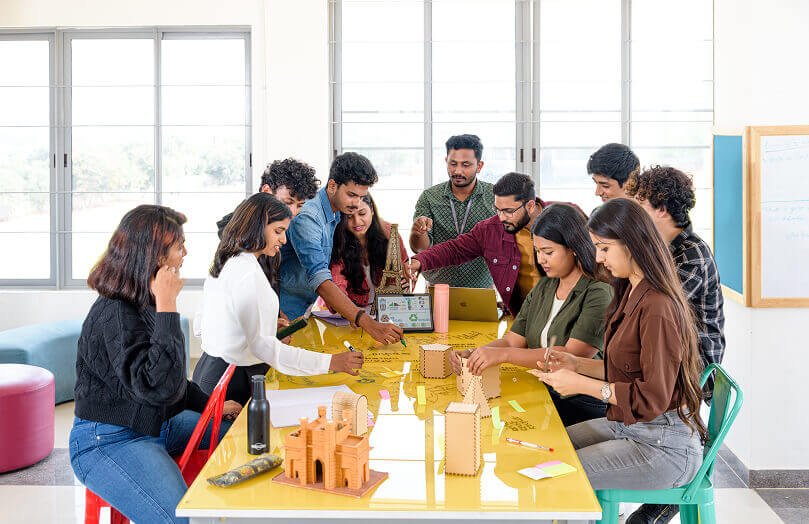
A space designed for students to brainstorm, collaborate and work together free of constraints, the main goal of the Design Thinking Lab is to encourage students to work together on solutions to real-world problems, often in their own communities.
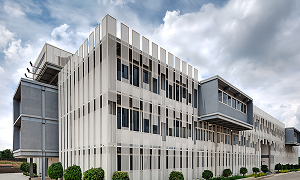
At present, there is one Design Thinking Lab at the Lakeside Campus, which is divided into zones and can comfortably accommodate at least 200 students at a time. The upcoming labs at the OMBR Campus, located in SOLS, and City Campus, on the first floor, are designed as smaller spaces for collaboration, each hosting approximately 60 students. All three labs will be equipped with whiteboards and workstations to encourage students to congregate and work on their ideas.
Inside the Lab at the Lakeside Campus
A sprawling 7,000-square-foot space, the Design Thinking Lab at the Lakeside Campus is where students attend their design thinking sessions, communicate, collaborate and bring solutions to life. With writable desks so students can scribble down ideas and modular furniture that can be rearranged according to their needs, the lab is a space designed for student comfort.
The lab is divided into three major zones:
Brainstorming Area: Designed to encourage creativity and teamwork, the Brainstorming Area, also known as the Ideation Zone, is where students collaborate and work on their ideas. The space is airy, with modular furniture, whiteboards and other writable surfaces for students to write their ideas quickly. It is designed as an open, flexible space that encourages the free flow of ideas within a relaxed environment.
Prototyping Area: The Prototyping Area is where students test and refine their ideas. Working in collaboration with the Makerspace, it provides access to tools such as 3D printers, cutting machines and a plastic grinding machine.
Presentation Areas: The main presentation area includes a large digital display, sound system and comfortable seating, creating an informal stage for pitch sessions, guest lectures, demo days and project showcases.
While the space is designed for students to work at their convenience without strict timings or booking requirements, the Design Thinking Lab is also used for formal events and workshops.
Skills Students Develop in the Lab Environment
At the Design Thinking Lab, students develop a range of classroom-based and real-world skills. The open layout, modular furniture and variety of equipment create a conducive environment for learning:
Design Thinking
Skills
Through the design thinking course conducted in the lab, students learn to apply principles such as empathy, problem identification, solution definition and prototyping, using tools and facilities available at the Makerspace.
Creativity & Innovation
The lab environment differs from traditional classrooms, featuring movable furniture, writable boards and desks designed for ideation, encouraging experimental thinking.
Communication & Presentation
Regular use of presentation areas enables students to practise pitching ideas, participating in discussions and receiving feedback, strengthening their communication and storytelling skills.
Critical Thinking
By engaging with real-world challenges, community-focused initiatives and United Nations Sustainable Development Goals (UNSDG)–aligned projects, students develop analytical thinking, solution testing and impact evaluation skills.
Creative Confidence & Resilience
The lab provides a supportive, judgement-free space that encourages experimentation and learning from failure, fostering confidence and resilience.
Collaboration
Students from diverse disciplines such as design engineering and architecture are encouraged to collaborate, combining skills and perspectives to produce innovative solutions.
Technical Exposure: Hands-On Learning in the Lab
While the Design Thinking Lab supports ideation and presentation, technical tools such as 3D printers, laser cutters, CNC routers and hand power tools are available in collaboration with the Makerspace to enable students to create working prototypes. Students may also bring personal Arduino and Raspberry Pi kits for experimentation.
All equipment requires mandatory training and safety gear, supplied through a central tools counter under supervision of the Lab In-Charge. This ensures safe usage while allowing students creative freedom to explore and iterate.
By teaching practical skills and building confidence with modern fabrication tools, the lab provides both technical infrastructure and guided support valuable for innovation and real-world problem-solving.
Design Thinking: The Heart of the Lab Experience
The principles of design thinking are brought to life in the Design Thinking Lab, allowing students to turn theory into practice and develop solutions to real-world problems. Design thinking promotes a human-centred approach to problem-solving that integrates empathy, creativity and experimentation. By cultivating adaptability, collaboration and empathy, design thinking equips students with the skills and mindset required to tackle complex challenges and drive meaningful impact across disciplines and industries.
This website uses cookies to improve your experience while you navigate through the website. Out of these cookies, the cookies that are categorized as necessary are stored on your browser as they are essential for the working of basic functionalities of the website. We also use third-party cookies that help us analyze and understand how you use this website. These cookies will be stored in your browser only with your consent. You also have the option to opt-out of these cookies. But opting out of some of these cookies may have an effect on your browsing experience.
Necessary cookies are absolutely essential for the website to function properly. This category only includes cookies that ensures basic functionalities and security features of the website. These cookies do not store any personal information.
Any cookies that may not be particularly necessary for the website to function and is used specifically to collect user personal data via analytics, ads, other embedded contents are termed as non-necessary cookies. It is mandatory to procure user consent prior to running these cookies on your website.