Institutional Innovation Council
Recognised as the number one leadership competency of the 21st century, Design Thinking is integral to CMRU’s academic fabric. Since 2021–22, it has been a compulsory part of all our undergraduate and postgraduate curriculum, regardless of discipline.
With over 3,800 students trained, CMRU is India’s first university to institutionalise Design Thinking across all programmes. Students apply research, empathy, ideation, and prototyping to solve real-world problems with creativity and intent.
Design Thinking begins with a simple belief: every challenge looks different when we begin with people. It is a human-centric approach to learning, inquiry, and problem-solving that places empathy at the centre of creation.
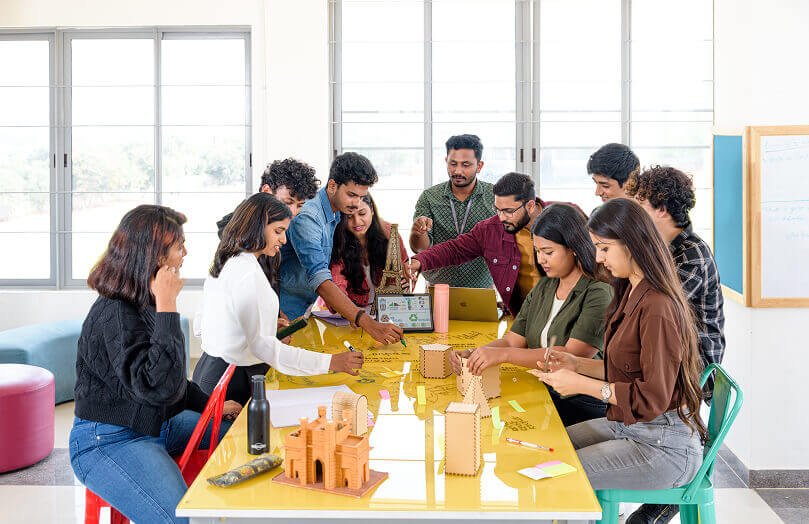
Whether students are designing a product, rethinking a community system, or improving a classroom experience, Design Thinking helps them observe patterns, explore perspectives, and transform ideas into meaningful impact.
At its root, it is more than a process; it is a mindset. A mindset that asks “Why not?” and then sets out to discover how.
Observe closely. Listen deeply. Step into the lives and needs of others to understand what the world looks like through their eyes.
At CMR University, Design Thinking is not restricted to a single department or course. It is woven into the fabric of our academic philosophy, a way of learning that cuts across disciplines and challenges.
Since 2021–22, every undergraduate and postgraduate student engages with Design Thinking through the Common Core Curriculum (CCC). With over 3,800 students trained so far, CMRU became one of India’s pioneers in making Design Thinking a university-wide requirement, ahead of the Karnataka Government’s current push to introduce design thinking in higher education.
The faculty integrates Design Thinking into coursework, studio explorations, labs, and community-based assignments. Students learn by engaging with real problems, prototyping solutions, and reflecting on how their ideas evolve.
The Design Thinking Lab acts as a creative pulse point, a space of modular workstations, microcontrollers, sensors, fabrication tools, and collaborative zones. Here, students:
Through this immersive ecosystem, CMRU cultivates clarity, empathy, adaptability, and a mindset that sees possibility everywhere.
Design Thinking Day is a flagship initiative by CMR University that brings together students, faculty, industry experts, and community stakeholders to collaboratively address pressing social, environmental, and economic challenges. Rooted in the principles of human-centred design and aligned with the UN Sustainable Development Goals (SDGs), the event encourages participants to apply creative problem-solving through interdisciplinary teamwork. Hosted by the School of Design, Cause 2025 serves as a dynamic platform for ideation, prototyping, and pitching innovative solutions that drive meaningful change. The day is a celebration of purpose-driven creativity, where design meets empathy, and imagination transforms into impact.
Cause-2025 saw an overwhelming response with over 770+ teams and over 3,000 students participating from 124 institutions across 13 countries and 75 cities. Countries represented included Brazil, UAE, Sri Lanka, and Oman, while Indian cities such as Delhi, Chennai, and Srinagar added to the diversity of the cohort.
Over 75+ projects were showcased, addressing real-world challenges through innovative, sustainable solutions. Highlights included products and prototypes of afforestation devices using AI drone Agribot, smart helmets with integrated IOT devices, IOT based smart vehicle accident alert systems, surplus food delivery system, AI integrated cleaning bot using UV technology for healthcare facilities and much more innovative products and solutions created using the design thinking approach.
The top teams demonstrated high-impact, scalable ideas aimed at real-world transformation. In the CMRU category, Team ‘Power Pair’ took home the top prize for their innovative sustainable packaging solution designed for food delivery apps. In the national category, Team ‘Luminous Pathfinder’ won first place with their glow-in-the-dark, self-charging road marking product. Meanwhile, in the international category, Team ‘Sanad’ from the UAE clinched the first prize for their patient-centric transportation service.
CMRU’s Global Design Thinking Platform
As an extension of the programme, CMRU created CAUSE, a global open innovation challenge where students tackle real-world problems through human-centred design.
CAUSE brings together students from schools and universities across the world, encouraging them to explore challenges aligned with the UN Sustainable Development Goals. Over recent editions:
took part, presenting ideas that ranged from sustainable packaging and smart safety systems to AI-enabled healthcare tools.
The final stage, Ground Zero, brings shortlisted teams in front of global innovators, funders, and industry mentors, giving students a space to pitch, refine, and elevate their work.
CAUSE is more than an event; it’s a celebration of purpose-driven creativity and a marker of CMRU’s commitment to nurturing future problem-solvers.
Cause 2025 – Design Thinking Day is a flagship initiative by CMR University that brings together students, faculty, industry experts, and community stakeholders to collaboratively address pressing social, environmental, and economic challenges. Rooted in the principles of human-centred design and aligned with the UN Sustainable Development Goals (SDGs), the event encourages participants to apply creative problem-solving through interdisciplinary teamwork. Hosted by the School of Design, Cause 2025 serves as a dynamic platform for ideation, prototyping, and pitching innovative solutions that drive meaningful change. The day is a celebration of purpose-driven creativity, where design meets empathy, and imagination transforms into impact.
Cause-2025 saw an overwhelming response with over 770+ teams and over 3,000 students participating from 124 institutions across 13 countries and 75 cities. Countries represented included Brazil, UAE, Sri Lanka, and Oman, while Indian cities such as Delhi, Chennai, and Srinagar added to the diversity of the cohort.
Over 75+ projects were showcased, addressing real-world challenges through innovative, sustainable solutions. Highlights included products and prototypes of afforestation devices using AI drone Agribot, smart helmets with integrated IOT devices, IOT based smart vehicle accident alert systems, surplus food delivery system, AI integrated cleaning bot using UV technology for healthcare facilities and much more innovative products and solutions created using the design thinking approach.
The top teams demonstrated high-impact, scalable ideas aimed at real-world transformation. In the CMRU category, Team ‘Power Pair’ took home the top prize for their innovative sustainable packaging solution designed for food delivery apps. In the national category, Team ‘Luminous Pathfinder’ won first place with their glow-in-the-dark, self-charging road marking product. Meanwhile, in the international category, Team ‘Sanad’ from the UAE clinched the first prize for their patient-centric transportation service.
Understand the full context of a situation and recognize its problem areas. Map what you know to define user needs, clarify priorities, and focus attention where it matters most.
Set aside assumptions and connect genuinely with users and stakeholders. By understanding their values, experiences, and mindsets, you can design solutions that are truly meaningful and human-centered.
Investigate the challenge to gather insights and test assumptions. Analyse data and observations to validate or refine ideas and develop a deeper understanding of the context.
Understand the full context of a situation and recognize its problem areas. Map what you know to define user needs, clarify priorities, and focus attention where it matters most.
Generate a wide range of ideas through creative brainstorming and divergent thinking. Encourage curiosity, experimentation, and “what if” thinking to uncover innovative possibilities.
Refine promising ideas into actionable concepts. Create prototypes to visualize and test your ideas early—learning, improving, and reducing risks through iteration.
Share prototypes with users and stakeholders to gather insights. Use feedback to refine, adapt, and strengthen your design for greater impact and usability.
Communicate your solution clearly and compellingly. Share your process, showcase your learnings, and inspire others to build, collaborate, and innovate further.
Evaluate what worked, what didn’t, and what could be improved. Reflection fosters growth, deepens understanding, and strengthens your next design journey through blended learning.
Every solution begins with a thoughtful question. Students map context, understand stakeholders, and pinpoint where change is possible.
Learners connect with real users, listen to stories, and observe behaviour, building solutions anchored in authentic needs.
Evidence guides the process. Students analyse data, test assumptions, and uncover insights.
Information becomes knowledge. Through synthesis tools, students recognise patterns and priorities.
Creativity expands. Learners generate a wide range of ideas, even unconventional ones, to stretch the landscape of possibilities.
Direction forms. Students refine, merge, and strengthen ideas into coherent concepts.
Thought becomes tangible. Prototypes help students test usability, clarity, and feasibility.
Insight emerges through critique. Feedback from peers, users, and faculty sharpens the idea.
Students articulate their journey with clarity and confidence, using documentation and storytelling to situate their work in wider conversations.
The world shifts fast, socially, technologically, and environmentally. Those who thrive are the ones who can think creatively, adapt responsibly, and respond with purpose.
Design Thinking empowers CMRU students with that mindset. It encourages them to question deeply, collaborate meaningfully, empathise sincerely, and build boldly. It turns imagination into action and makes learning a lived, evolving experience.
At CMRU, Design Thinking is both a classroom and a launchpad, a space where today’s curiosity grows into tomorrow’s solutions.
K-UGCET Codes
B.Tech Lakeside Campus - E257
B.Arch Lakeside Campus - E245
MBA (OMBR Campus) - B149MB
MBA (City Campus)- B150MB
MBA (Lakeside Campus) - B395MB
MCA (OMBR Campus) - C527MC
MCA (Lakeside Campus)- C521MC