cmr.edu.in Department of Common Core Curriculum | CMR University ...
REQUEST CALL-BACK

Student
Development

Department of
Common Core Curriculum

With the vision “to nurture creative thinkers who will drive positive global change,” CMR University strives to equip students with 21st-century competencies required to thrive in the “University of Life”. Toward this goal, the Department of Common Core Curriculum (DCCC) prepares all students enrolled in undergraduate and postgraduate programmes across the University:

  • For a future they do not yet know
  • For jobs that do not exist today
  • For the challenges that lie ahead in life

Interlaced with the Programme Core Curriculum (PCC), the Common Core Curriculum (CCC) courses are mandatory for all students, irrespective of the academic programme they pursue.

These courses are designed
under
three foundational aspects

01

Preparing for
Success

Building successful career pathways, including entrepreneurship, higher education, research and job opportunities.

02

Contributing to
Society

Empowering socially conscious, empathetic and responsible future leaders.
03

Knowing Self
and Community

Understanding the importance of inquiry at the individual, national and global levels, with cultural awareness and ethics.

The Common Core Curriculum (CCC) was launched in the academic year 2021–22 and is offered as both credit and graduate-requirement courses. All students must complete these courses, along with their programme curriculum requirements, to be eligible for graduation. All CCC courses are reflected in the University’s grade card or grade certificate issued at the end of each semester.

CCC’s Community Service Programme (CSP)

Through the CCC Community Service Programme (CSP) that was launched in 2022, the University aims to build socially conscious and ethically responsible future leaders by encouraging students to take an active role in citizenship.

Under the CSP, students must complete a minimum number of volunteering hours each semester by rendering services to the community and collecting evidence in the form of Volunteering Tracking Letters (VTLs) from the authorities concerned. Upon completing the required number of hours for their programme, students must submit a Reflection Record (RRD) detailing their learning, experiences, and the impact of their work. This submission is mandatory to fulfil graduation requirements.

What DCCC Does

Designs University-wide Learning Frameworks

DCCC leads the Common Core Curriculum (CCC),  the shared academic experience for all students. It keeps the curriculum interdisciplinary, relevant, and rooted in real-world application.

Builds Core Skills for Every Student

Through communication modules, design thinking, career preparedness, and reflective practice, the department strengthens how students think, speak, collaborate, and solve problems.

Connects Students with Society

DCCC manages the Community Service Programme (CSP), where students engage with NGOs and local communities, completing structured service hours that build empathy and social awareness.

Shapes Identity, Inquiry & Perspective

Courses in cultural understanding, Indian Knowledge Systems, foreign languages, and interdisciplinary electives encourage students to reflect deeply and broaden their worldview.

Curates Flagship Events & Impact Spaces

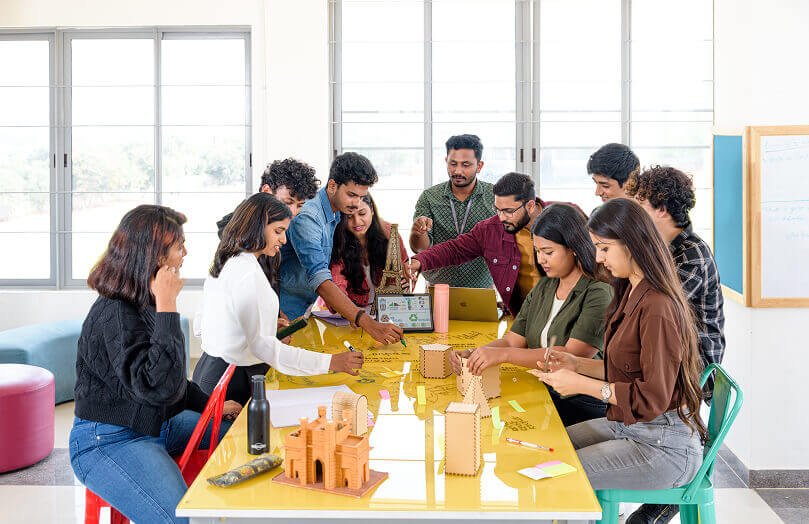
DCCC creates spaces where ideas take form — through exhibitions, leadership summits, international showcases, rural immersion, and innovation challenges.

DCCC Highlights

Events, Achievements & Impact

DCCC’s work comes alive through moments that bring students, faculty, industry experts, and communities together. This year, the department led initiatives across all campuses that shaped learning in powerful ways:

Innovation & Design Thinking

The GDTA India Chapter was launched at CMRU with Prof. Uli Weinberg, placing the university within a global design-thinking network.

Over 750 students showcased projects during the Designing for the Next Billion exhibition.

Students earned international recognition — fully funded scholarships to Singapore, awards at India Sustainability Startathon, and representation at ASEAN–China–India Youth Leadership Summits.

CAUSE
Design Thinking Day

A global event hosted by CMRU with:

770+ teams, 3,000+ students, 124 institutions, 13 countries, 75 cities.
Projects featured AI-driven sustainability tools, community-focused devices, packaging innovations, and socially impactful solutions that upskills graduates who are socially conscious, and globally aware.

Community & Social Immersion

  • Students participated in the Rural Immersion Camp, engaging with village communities and mapping real world challenges.

  • Community Service activities surpassed crucial milestones in volunteering hours, partnerships, and outreach.

Skill-Building, Employability & Literacy

  • World Youth Skills Day brought competitions and interactions across campuses.
  • Soft skills and employability workshops strengthened communication and interview preparation.
  • World Literacy Day and cross-campus activities highlighted the importance of language and expression.

Research & Faculty Excellence

Faculty published in international journals, presented at national and global conferences, filed patents, and participated in academic development programmes  contributing to a stronger academic culture within the department.

These highlights reflect what DCCC stands for: learning that moves, evolves, and stays connected with the world.

CCC at a Glance

A quick overview of the Common Core Curriculum managed by the DCCC:

  • Design Thinking (mandatory for all UG & PG)
  • Career Preparedness Programme (Discover–Build–Deliver)
  • Oral & Written Communication
  • Community Service Programme
  • Foreign Languages
  • Skill Enhancement Courses
  • Indian Knowledge System
  • Reflective Practice & Interdisciplinary Electives
ACCP AY(2025-26)
Seraphinite AcceleratorOptimized by Seraphinite Accelerator
Turns on site high speed to be attractive for people and search engines.