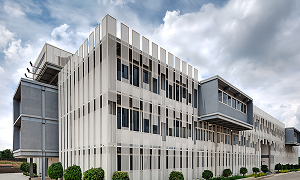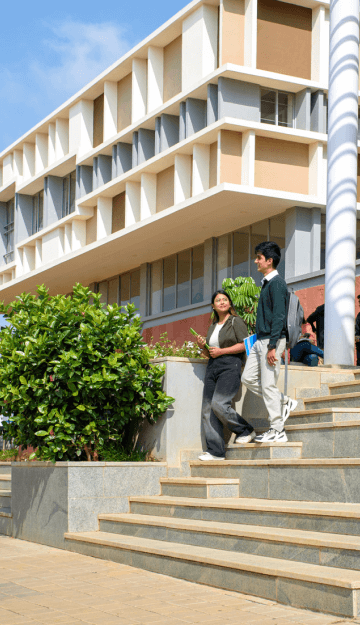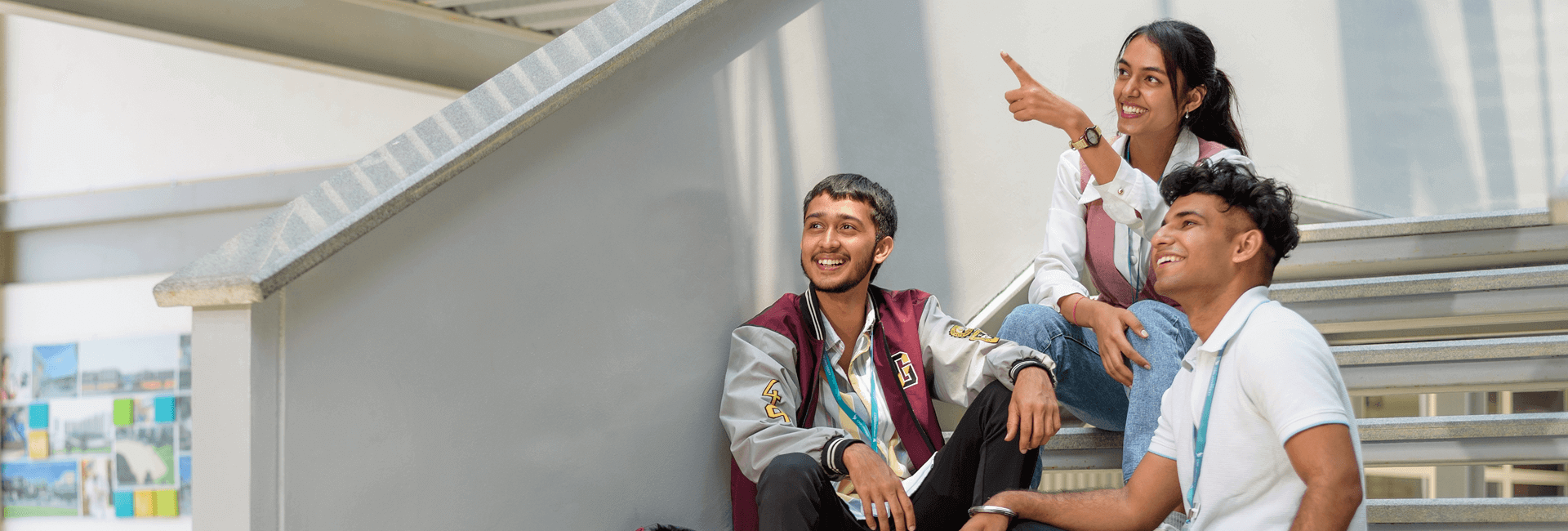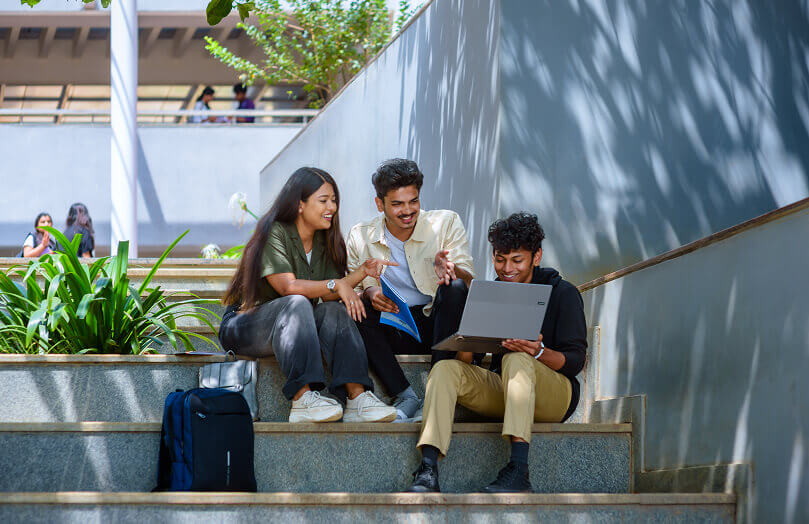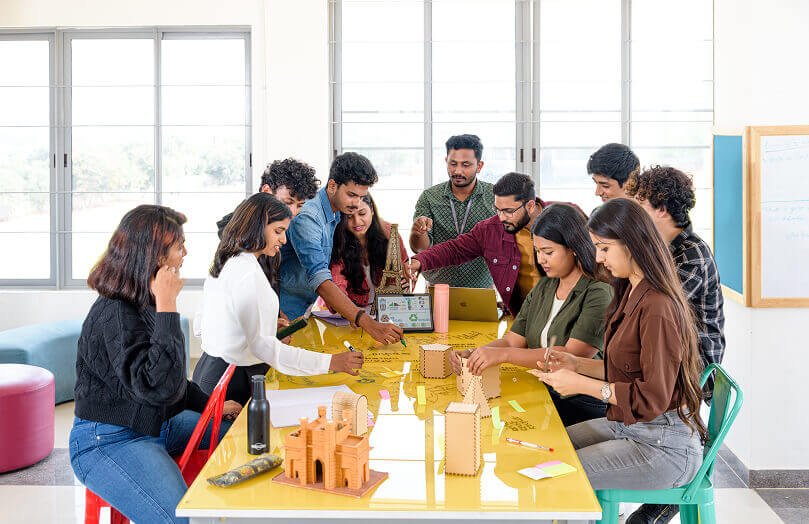

A space designed for students to brainstorm, collaborate and work together free of constraints, the main goal of the Design Thinking Lab is to encourage students to work together on solutions to real-world problems, often in their own communities.
At present, there is one Design Thinking Lab at the Lakeside Campus, which is divided into zones and can comfortably accommodate at least 200 students at a time. The upcoming labs at the OMBR Campus, located in SOLS, and City Campus, on the first floor, are designed as smaller spaces for collaboration, each hosting approximately 60 students. All three labs will be equipped with whiteboards and workstations to encourage students to congregate and work on their ideas.
A sprawling 7,000-square-foot space, the Design Thinking Lab at the Lakeside Campus is where students attend their design thinking sessions, communicate, collaborate and bring solutions to life. With writable desks so students can scribble down ideas and modular furniture that can be rearranged according to their needs, the lab is a space designed for student comfort.
The lab is divided into three major zones:
Prototyping Area: The Prototyping Area is where students test and refine their ideas. Working in collaboration with the Makerspace, it provides access to tools such as 3D printers, cutting machines and a plastic grinding machine.
At the Design Thinking Lab, students develop a range of classroom-based and real-world skills. The open layout, modular furniture and variety of equipment create a conducive environment for learning:
While the Design Thinking Lab supports ideation and presentation, technical tools such as 3D printers, laser cutters, CNC routers and hand power tools are available in collaboration with the Makerspace to enable students to create working prototypes. Students may also bring personal Arduino and Raspberry Pi kits for experimentation.
All equipment requires mandatory training and safety gear, supplied through a central tools counter under supervision of the Lab In-Charge. This ensures safe usage while allowing students creative freedom to explore and iterate.
By teaching practical skills and building confidence with modern fabrication tools, the lab provides both technical infrastructure and guided support valuable for innovation and real-world problem-solving.
The principles of design thinking are brought to life in the Design Thinking Lab, allowing students to turn theory into practice and develop solutions to real-world problems. Design thinking promotes a human-centred approach to problem-solving that integrates empathy, creativity and experimentation.
By cultivating adaptability, collaboration and empathy, design thinking equips students with the skills and mindset required to tackle complex challenges and drive meaningful impact across disciplines and industries.

School of Architecture (SOA)
School of Design (SOD)
School of Engineering & Technology (SOET)
School of Economics & Commerce (SOEC)
School of Management (SOM)
School of Legal Studies (SOLS)
School of Science & Computer Studies (SSCS)
CMR UNIVERSITY ADMIN OFFICE
#2, 3rd 'C' Cross, 6th 'A' Main HRBR Layout, 2nd Block, Kalyana Nagar,Bengaluru 560043, India.
CMRU CITY CAMPUS
LAKESIDE CAMPUS
CMRU OMBR CAMPUS
CMRIT
Andhra Pradesh & Telangana
FOR ADMISSION ENQUIRIES CONTACTK-UGCET Codes
B.Tech Lakeside Campus - E257
B.Arch Lakeside Campus - E245
MBA (OMBR Campus) - B149MB
MBA (City Campus)- B150MB
MBA (Lakeside Campus) - B395MB
MCA (OMBR Campus) - C527MC
MCA (Lakeside Campus)- C521MC
 Optimized by Seraphinite Accelerator