CMR University has proudly secured Rank No. 9 in India in the Most Improved General University category and Rank No. 43 in India in the India's Best Universities category in the India Today Magazine – August 2026 Issue.
Important Update for Ph.D. Applicants and Research Scholars: The entrance and coursework examinations scheduled on 24th and 25th July 2026 have been rescheduled to 31st July and 1st August 2026 respectively.
Candidate should have passed the 2nd PUC/12th/Equivalent Exam with a minimum of 45% of marks in Physics and Mathematics along with Chemistry/ Computer Science/Electronics/Information Technology/ Biology/ Informatics Practices/ Biotechnology/ Technical Vocational subject/ Agriculture/ Engineering Graphics/ Business Studies/ Entrepreneurship. (40% for Karnataka reserved category candidates) from a recognized board. Candidates must also qualify in one of the following entrance exams: CET/ COMED-K/JEE/Other state entrance tests /National level entrance test.
OR
Passed D.Voc. stream in the same or allied sector.
Scope & Objectives
One of the most sought-after engineering branches, Computer Science Engineering incorporates both computer engineering and computer science. Tailor-made for the tech-savvy, students learn the key aspects such as networking, programming, software development, and testing.
CMR University’s Computer Science Engineering courses are designed as a bridge between software and hardware components of computers, thereby ensuring that students delve deep into areas such as system software, programming languages, cloud computing, artificial intelligence, machine learning, the Internet of Things, data analytics, and big data.
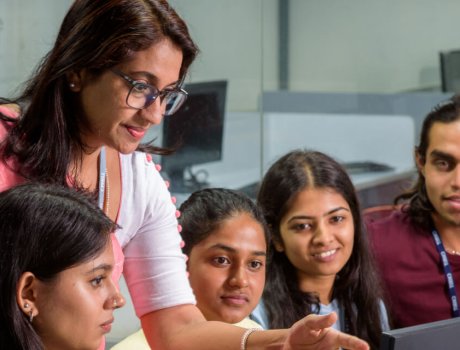
Automation is also a key focus area of the programme. Under expert faculty guidance, students are prepared for careers as software engineers, programmers, data scientists, hardware engineers, and researchers.
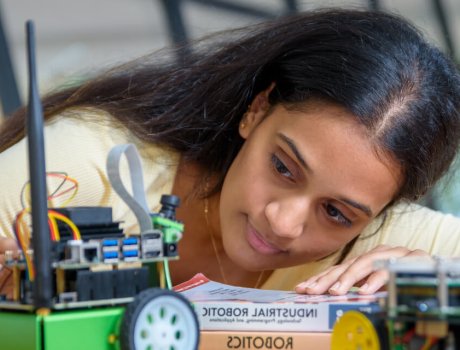
With computer science skills in high demand both in India and globally, the career opportunities are immense. Practical knowledge is highly valued, and with CMR University’s state-of-the-art laboratories, students gain substantial industry exposure and practical insights.
Programme Structure
Semester (Physics Cycle) I / II
Engineering Mathematics with Python Lab I & II
Engineering Physics
Engineering Chemistry
Fundamentals of Electrical Engineering
Fundamentals of Electronics Engineering
Engineering Mechanics
Elements of Computer Engineering
Problem Solving using Python
Programming in C
Creating with AI
Design Thinking
Active Communication Languages
Community Service Program
III Semester
Probability, Statistics and Numerical Methods
Object-Oriented Programming with Java
Data Structures
Computer Organization and Architecture
Software Engineering
Making with Electronics
Career Preparedness
Indian Constitution
Community Service Program
Internship
IV Semester
Discrete Mathematics and Combinatorics
Operating Systems
Database Management Systems
Theory of Computation
Design and Analysis of Algorithms
Introduction to Philosophical Thoughts
Career Preparedness
Community Service Program
V Semester
Cloud Computing
Web Development using Python and Django
Data Communication and Computer Networks
Open Elective I
Professional Elective I
Interdisciplinary Elective I
Indian Traditions: Values and Critical Inquiry
Disaster Management
Training & Placement
Internship
VI Semester
Artificial Intelligence
Python for Data Science
Mobile Application Development
Computer Networks
Open Elective II
Professional Elective II
Interdisciplinary Elective II
Environment and Sustainability
Contributing to Society
Training and Placement
VII Semester
Introduction to Machine Learning
Professional Elective III
Professional Elective IV
Interdisciplinary Elective III
Business Management for Engineers
Capstone Project Phase I
Internship
Training and Placement
VIII Semester
Capstone Project Phase – II
Industrial Internship
Open Elective I
Digital Image Processing
Fundamentals of Robotics and Applications
Remote Sensing and Applications
Professional Elective Specialisations
Data Science
Cyber Security
Application Development
Artificial Intelligence
Networking
Professional Elective I
Advanced Python for AI
Data Mining
R Language
Software Security
Secure Coding
Cryptography
Advanced Java
Scripting Languages
Kotlin (OO + Functional)
Introduction to DevOps and
Microservice Architecture
Human Computing Interface with IoT
Creative AI and No-code Automation
Professional Elective II
Soft Computing (Fuzzy, Genetic, Ontologies)
No-SQL Databases
Applied Machine Learning
System Security
Ethical Hacking
Malware Analysis
Object Oriented Analysis and Design
Web Technology Frameworks
Application Development using MERN Stack
Game Theory
Cyber Crime Management
Cyber Hub and Kali Linux
Professional Elective III & IV
Deep Learning
Computer Vision
Big Data and Data Analytics
Robotic Process Automation
Mobile Computing Security
Digital Forensics
Cloud Computing Security
Web Security
J2EE Technologies
.NET Technologies
Java Script
Microservices
Software Defined Networks
Storage Area Networks
Virtualisation & Cloud Computing
Network Administration
Image and Video Forensics
Introduction to Quantum Computing
Introduction to Blockchain Technologies
Open Elective II
Advanced Robotics: Integration of Control, Programming and AI
Geographic Information System & Applications
Advanced Digital Image Processing
Programme Assessment
Choice-Based Credit System (CBCS): Allows students to choose courses and earn credits based on performance.
Grades and GPA: Each course contributes to the SGPA and overall CGPA, measuring academic progress.
Prescribed Curriculum: Includes required courses, labs, and MOOCs (SWAYAM).
Auditing Courses: Students may audit additional courses for broader learning without grade pressure.
Evaluation System: Continuous Internal Evaluation (CIE) and Semester-End Examination (SEE), each contributing 50% to final marks.
Assessment Methods: Includes assignments, seminars, group discussions, presentations, projects, research work, mooc course completion, etc.
Makeup Examinations: Offered to students who fail SEE, allowing grade improvement.
Programme Outcome
Engineering Knowledge: Apply the knowledge of Mathematics, Science, Engineering Fundamentals, and an engineering specialisation for solving complex engineering problems.
Design/Development of Solutions: Design solutions for complex Engineering problems and Design System Components or processes that meet the specified needs with appropriate consideration for the public health and safety, and the cultural, societal, and environmental considerations.
Conduct investigations of complex problems: Use research–based knowledge and research methods including Design of Experiments, Analysis and Interpretation of data, and synthesis of information to provide valid conclusions.
Modern Tool usage: Create, select, and apply; appropriate techniques, resources, and modern engineering and IT tools including Prediction and Modelling to complex engineering activities with an understanding of the limitations.
The Engineer and Society: Apply, reasoning informed by the contextual knowledge to assess Societal, Health, Safety, Legal and Cultural issues and the consequent responsibilities relevant to the professional Engineering practice.
Environment and sustainability: Understand the impact of the professional Engineering solutions in Societal and Environmental contexts, and demonstrate the knowledge need for sustainable development.
Ethics: Apply ethical principles and commit to professional ethics and responsibilities and norms of the Engineering practice.
Individual and team work: Function effectively as an individual, and as a member or leader in diverse teams, and in multidisciplinary settings.
Communication: Communicate effectively on complex Engineering activities with the Engineering community and with society at large, such as, being able to comprehend and write effective reports and design documentation, make effective presentations, and give & receive clear instructions.
Project Management and Finance: Demonstrate knowledge and understanding of the Engineering and Management principles and apply these to one’s own work, as a member and leader in a team, to manage projects in multidisciplinary environments.
Life–long learning: Recognise the need for, and have the preparation and ability to engage in independent and life–long learning in the broadest context of technological change.
1. Tredence, Bengaluru, India – Rs.12,00,000 (CTC per annum)
2. EcoLab, Bengaluru, India – Rs. 9,00,000 (CTC per annum)
3. TESCO, Bengaluru, India – Rs. 8,00,000/-(CTC per annum)
4. EMPOWER, Bengaluru, India – Rs. 7,00,000/-(CTC per annum)
5. Ey Global Delivery Services, Bengaluru, India
6. Eurofins, Bengaluru, India – Rs.10,00,000/- (CTC per annum)
7. Esyasoft Technologies, Bengaluru, India – Rs.8,00,000/- (CTC per annum)
8. Maximus, Bengaluru, India – Rs. 7,50,000/- (CTC per annum)
9. CGI, Bengaluru, India – Rs. 6,00,000/- (CTC per annum)
The admission process may vary depending on the institution, but generally, students must have completed their 10+2 or equivalent examination and secured a minimum of 45% aggregate marks in the examination.
The duration of the programme is four years.
The online application is for admission to programmes offered in CMR University.
Scholarship
CMR Memorial Scholarship
CMR Merit Scholarship
CMR Leadership Award
CMR Sports Scholarship
Students can also apply for Government Scholarships
Special quota for NCC/NSS and others through CET allotment
10+2 with physics, chemistry, and mathematics as subjects and a minimum of 45% marks in 10+2. Other equivalent qualifications may also be considered.
Yes, it covers almost all areas of computing. CMR University, one of the top Computer Science Engineering colleges in Karnataka, is an excellent choice for the B.Tech. in CSE course. Our course includes modules on network security, data structures, mobile application development, data mining, big data, artificial intelligence, cryptography, digital forensics, and data analytics.
B.Tech. in CSE is one of the best courses available for securing a stable professional future. Study B.Tech. in CSE at one of the top private universities for Computer Science in Bangalore, CMR University. The software and IT industries are emerging fields with many innovations. An undergraduate course in Computer Science will help you build a strong career foundation.
The following are the major skills required to be a computer science engineer
Analytical skills
Creativity
Basics of machine learning
Web development knowledge
Programming skills
Critical thinking
Problem-solving skills
Data structures
Algorithms
Network security basics
Cryptography basics
Quick learning abilities.
The Job opportunities for Computer Science engineers include:
Software Developer
Computer Hardware Engineer
Web Developer
Computer Programmer
Game Developer
App Developer
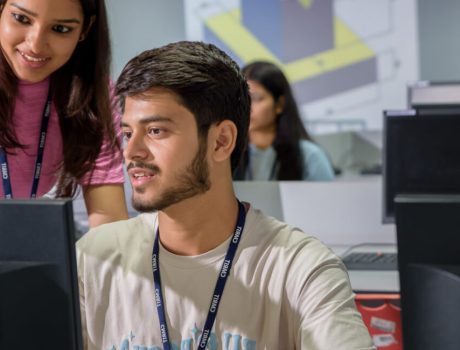
The Department of CSE at CMR University offers facilities such as a Data Structures laboratory, labs for programming with Python, a lab for problem-solving programming, a Data Structures and Algorithms lab, a Java programming lab, and a Database Management Systems lab. Additionally, spacious classrooms are equipped with electronic infrastructure for audio-visual teaching aids, rapid prototyping labs, and a conference room for discussions.
Log in to the portal on our website, download the admission form, and fill it out. You can either submit the form in person at the college campus or submit it online after payment of the application fees. If you are shortlisted, you will receive a call for an interview.
Yes, Computer Science engineers are in high demand. With the growth of automation and AI technology, there is a significant need for Computer Science engineers to analyse big data and data analytics. This subject serves as the foundation for many subfields in engineering, creating substantial demand for Computer Science engineers.
Yes, at CMR University we have a dedicated placement cell that comprises experienced professionals from various fields of engineering to train the students to attend the placement interviews. We also help the students develop their soft skills and leadership skills from the first year through various modules.
Yes, the BTech course at CMR University provides students with practical training and internship opportunities as part of the curriculum.
This website uses cookies to improve your experience while you navigate through the website. Out of these cookies, the cookies that are categorized as necessary are stored on your browser as they are essential for the working of basic functionalities of the website. We also use third-party cookies that help us analyze and understand how you use this website. These cookies will be stored in your browser only with your consent. You also have the option to opt-out of these cookies. But opting out of some of these cookies may have an effect on your browsing experience.
Necessary cookies are absolutely essential for the website to function properly. This category only includes cookies that ensures basic functionalities and security features of the website. These cookies do not store any personal information.
Any cookies that may not be particularly necessary for the website to function and is used specifically to collect user personal data via analytics, ads, other embedded contents are termed as non-necessary cookies. It is mandatory to procure user consent prior to running these cookies on your website.