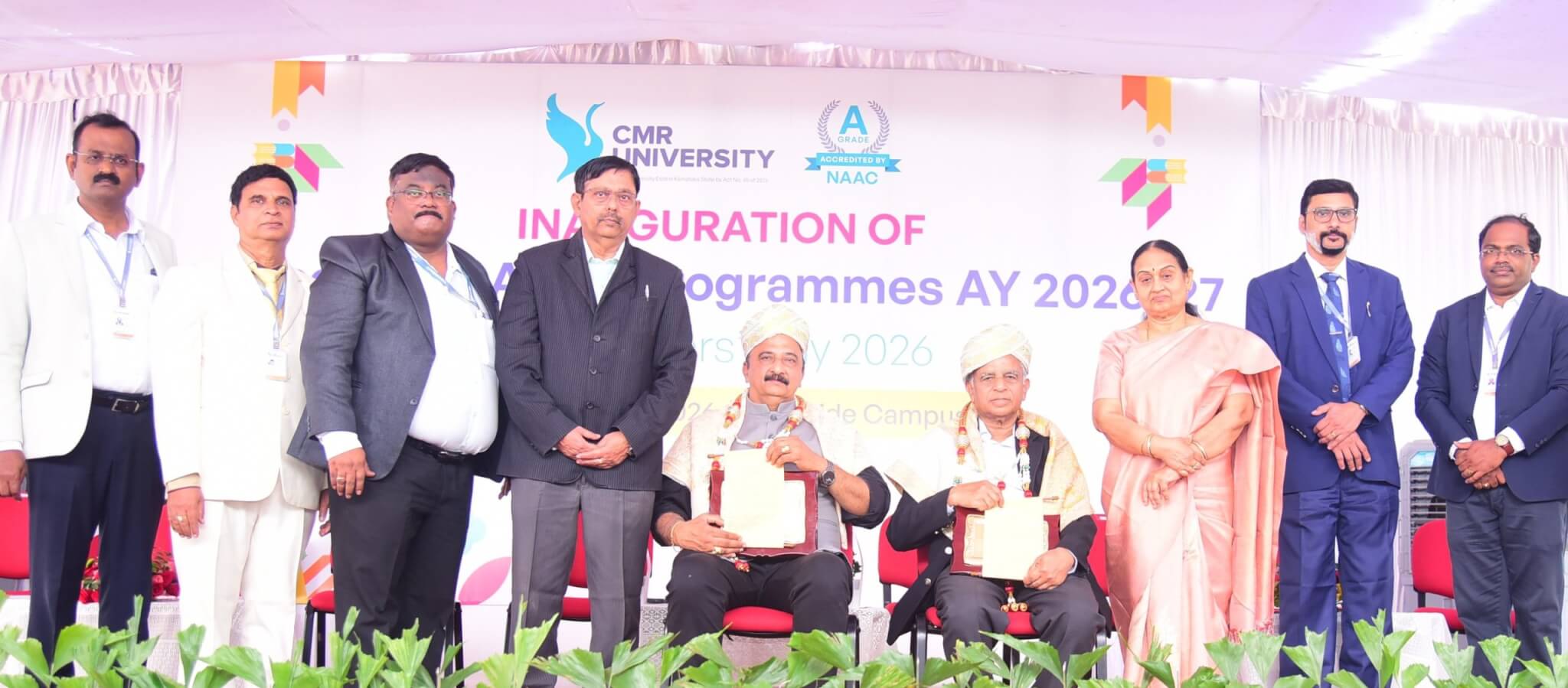
CMR University has proudly secured Rank No. 9 in India in the Most Improved General University category and Rank No. 43 in India in the India's Best Universities category in the India Today Magazine – August 2026 Issue.
Important Update for Ph.D. Applicants and Research Scholars: The entrance and coursework examinations scheduled on 24th and 25th July 2026 have been rescheduled to 31st July and 1st August 2026 respectively.
The B.Sc. Information Technology (Artificial Intelligence and Machine Learning) programme offered by the School of Science and Computer Studies (SSCS) is designed to provide students with a strong foundation in information technology and advanced knowledge of artificial intelligence and machine learning. The curriculum combines theoretical learning with practical experience through laboratory sessions, industry projects, internships, and research activities. Students develop technical, analytical, and problem-solving skills to design intelligent solutions for real-world challenges. The programme also emphasises ethical computing, innovation, communication, teamwork, and lifelong learning, enabling graduates to pursue successful careers, higher education, research and entrepreneurship in the rapidly evolving field of AI and digital technology.
Duration
3 years / 6 semesters
Programme Fees
Rs. 50,000 per semester
For detailed information on fee concessions and scholarships, please contact our Admissions Office at +91 9342900666.
The B.Sc. Information Technology with Artificial Intelligence and Machine Learning programme offered by the School of Science and Computer Studies (SSCS) prepares students for emerging careers in intelligent computing, data-driven technologies, and digital transformation. The programme aims to develop strong technical knowledge in information technology, artificial intelligence, machine learning, data science, cloud computing, and cybersecurity. It emphasises analytical thinking, programming proficiency, innovation, ethical practices, and problem-solving through practical learning, industry collaborations, and research activities. Graduates will be equipped to pursue careers in software development, AI applications, data analytics, higher education, research, and entrepreneurship while adapting to the evolving demands of the global technology industry.
Programme Structure
Semester I
Problem Solving Techniques Using C and Lab
Database Management Systems and Lab
Mathematical Foundation for Computer Science
Language
Common Core Courses
Community Service Programme – I
Semester II
Data Structures using C and Lab
Operating System & Linux Foundation and Lab
Statistics
Interdisciplinary Elective I
Language
Common Core Courses
Community Service Programme – II
Semester III
Introduction to Artificial Intelligence
Python Programming
Web Technologies
Interdisciplinary Elective II
Excel for Data Analysis
Common Core Courses
Community Service Programme – III
Semester IV
Introduction to Data Science
Software Engineering and Lab
Cloud Computing
MOOC
Interdisciplinary Elective III
Common Core Courses
Semester V
Data Communication Networks
Blockchain Technology
Deep Learning and Lab
Internship
Elective 1:
Big data analytics
Ethical hacking and Cyber law
Environment and Sustainability
Common Core Courses
Semester VI
Information Technology and Cyber Security
Internet of Things Lab
Common Core Courses
Elective 2:
Data Visualisation and Lab
Big Data Analytics and Lab
Capstone Project
Programme Assessment
The School of Science and Computer Studies (SSCS), CMR University, follows the Choice-Based Credit System (CBCS) in accordance with the University regulations. This flexible academic framework enables students to select courses based on their interests and programme requirements while earning credits through successful completion of each course.
Choice-Based Credit System (CBCS)
The CBCS framework provides flexibility in learning by allowing students to choose elective and interdisciplinary courses. Credits are awarded based on successful completion of the prescribed curriculum, encouraging academic excellence and multidisciplinary learning.
Grading and Academic Performance
Student performance is evaluated using a letter grading system. At the end of each semester, the Semester Grade Point Average (SGPA) is calculated to assess semester-wise academic achievement, while the Cumulative Grade Point Average (CGPA) reflects the student’s overall academic performance across all semesters.
Curriculum Requirements
Each programme follows an approved curriculum that includes core courses, elective courses, laboratory sessions, internships, projects, and other academic requirements. To promote self-paced and lifelong learning, students are encouraged to complete relevant SWAYAM and Massive Open Online Courses (MOOCs) offered by recognised institutions, subject to University guidelines.
Audit Courses
Students may enrol in audit courses to acquire additional knowledge and develop new skills without earning academic credits or grades. These courses provide opportunities to enhance professional competencies and improve career readiness.
Evaluation System
The University adopts a Continuous and Comprehensive Evaluation (CCE) approach. Assessment consists of Continuous Internal Evaluation (CIE) and the Semester End Examination (SEE), each carrying 50% weightage, resulting in a total of 100 marks for every course, irrespective of the credit assigned.
Continuous Internal Evaluation
The Continuous Internal Evaluation is conducted throughout the semester using a variety of assessment methods, including assignments, quizzes, seminars, presentations, laboratory work, case studies, group discussions, practical exercises, project reviews, and industry-based activities. The evaluation pattern and weightage are determined by the course instructor in accordance with University regulations.
Semester End Examination
The Semester End Examination is conducted at the end of each semester for all eligible students enrolled in the respective courses. Certain courses that are entirely practice-oriented or based on continuous assessment may be evaluated solely through CIE, as specified in the curriculum.
Makeup Examinations
Students who are unable to pass one or more courses in the Semester End Examination are provided with an opportunity to appear for makeup examinations in accordance with the regulations of CMR University. Successful completion of these examinations enables students to improve their academic performance and progress toward the award of the degree.
Programme Outcome:
Upon successful completion of the B.Sc. Information Technology with Artificial Intelligence and Machine Learning programme offered by the School of Science and Computer Studies (SSCS), CMR University, graduates will be able to:
PO1: Computing Knowledge
Apply fundamental concepts of Information Technology, Artificial Intelligence, Machine Learning, mathematics, and computing principles to identify, analyse, and solve real-world computing problems.
PO2: Problem Analysis
Analyse complex technical problems using logical reasoning, data-driven approaches, and computational techniques to develop efficient, reliable, and scalable solutions.
PO3: Design and Development of Intelligent Solutions
Design, develop, implement, and evaluate software applications and AI-based systems using appropriate programming languages, algorithms, modern tools, and emerging technologies to address societal and industrial needs.
PO4: Research and Innovation
Apply research methodologies, analytical skills, and experimental techniques to investigate computing challenges, interpret results, and contribute innovative solutions in Information Technology and Artificial Intelligence.
PO5: Modern Tool Usage
Select and effectively use contemporary software tools, cloud platforms, AI frameworks, data analytics techniques, and development environments for building secure and intelligent computing applications.
PO6: Professional Ethics and Sustainability
Demonstrate ethical responsibility, professional integrity, cybersecurity awareness, and an understanding of the social, environmental, legal, and sustainability aspects associated with Information Technology and Artificial Intelligence.
PO7: Communication and Teamwork
Communicate technical concepts effectively through oral, written, and digital media, and collaborate productively as an individual or as a member of multidisciplinary teams.
PO8: Lifelong Learning and Employability
Recognise the importance of continuous learning, professional development, entrepreneurship, and adaptability to emerging technologies, enabling successful careers, higher education, research, and leadership in the global IT industry.
PO9: Leadership and Project Management
Demonstrate leadership, project planning, decision-making, and management skills to successfully execute Information Technology and Artificial Intelligence projects while working effectively in multidisciplinary and multicultural environments.
PO10: Industry Readiness and Entrepreneurial Mindset
Develop industry-relevant technical competencies, innovative thinking, and entrepreneurial skills to create technology-driven solutions, adapt to evolving industry requirements, and contribute to startups, organisations, and society.
Course Outcomes
Upon successful completion of the B.Sc. Information Technology with Artificial Intelligence and Machine Learning programme, students will be able to:
CO1: Apply the fundamental concepts of Information Technology, Artificial Intelligence, Machine Learning, mathematics, and programming to solve computing problems effectively.
CO2: Design, develop, test, and deploy software applications and intelligent systems using appropriate programming languages, algorithms, databases, and modern computing tools.
CO3: Analyse structured and unstructured data using statistical methods, machine learning techniques, and data visualisation tools to support informed decision-making.
CO4: Demonstrate professional ethics, cybersecurity awareness, effective communication, teamwork, and project management skills while developing technology-driven solutions for real-world applications.
CO5: Engage in lifelong learning by adapting to emerging technologies, conducting research, pursuing innovation, and applying entrepreneurial skills to address industrial and societal challenges.
What expertise do you gain?
The B.Sc. Information Technology with Artificial Intelligence and Machine Learning programme offered by the School of Science and Computer Studies (SSCS), CMR University is designed to bridge academic learning with industry expectations. Students gain the following academic and professional competencies:
Strong Academic Foundation: Develop comprehensive knowledge in Information Technology, Artificial Intelligence, Machine Learning, Data Science, Algorithms, Databases, and Software Engineering.
Industry-Relevant Technical Skills: Acquire hands-on expertise in programming, cloud computing, cybersecurity, web technologies, intelligent systems, and modern software development tools used by the IT industry.
Experiential Learning: Strengthen practical knowledge through laboratory sessions, case studies, mini-projects, capstone projects, internships, and industry-sponsored assignments.
Artificial Intelligence and Data Analytics: Learn to develop AI-enabled applications, build machine learning models, analyse large datasets, and generate data-driven insights for business and societal applications.
Research and Innovation: Participate in research projects, innovation challenges, technical competitions, and hackathons that promote creative thinking and technology development.
Industry Collaboration: Benefit from guest lectures, workshops, certification programmes, industrial visits, mentoring by industry experts, and collaborative projects with technology organisations.
Professional and Employability Skills: Enhance communication, teamwork, leadership, critical thinking, problem-solving, project management, and ethical decision-making required in professional environments.
Emerging Technology Exposure: Gain knowledge of rapidly evolving technologies such as Generative AI, Internet of Things (IoT), Cloud Computing, Big Data Analytics, DevOps, and Intelligent Automation.
Career Readiness: Build competencies aligned with industry requirements, preparing graduates for roles such as Software Developer, AI/ML Engineer, Data Analyst, Cloud Engineer, Cybersecurity Analyst, Business Intelligence Associate, and IT Consultant.
Higher Education and Entrepreneurship: Establish a strong academic and technical foundation for postgraduate studies, research, professional certifications, innovation-driven startups, and lifelong learning in the global technology ecosystem.
Career Opportunities
Graduates of the B.Sc. Information Technology with Artificial Intelligence and Machine Learning programme offered by the School of Science and Computer Studies (SSCS), CMR University can pursue diverse career opportunities in IT and technology-enabled industries. Some of the prominent career roles include:
01
Software Developer
02
Artificial Intelligence (AI) Engineer
03
Machine Learning Engineer
04
Data Analyst
05
Business Intelligence Analyst
06
Python Developer
07
Full Stack Developer
08
Web Application Developer
09
Cloud Support Engineer
10
Cybersecurity Analyst
11
Database Administrator
12
System Administrator
13
Software Test Engineer (QA Engineer)
14
IT Consultant
15
Technical Support Engineer
These career opportunities enable graduates to work across sectors such as Information Technology, Banking and Financial Services (BFSI), Healthcare, Manufacturing, Retail, E-commerce, Telecommunications, Education, Government, Logistics, and emerging technology-driven enterprises. The industry-oriented curriculum, internships, capstone projects, and placement support at the School of Science and Computer Studies (SSCS), CMR University prepare students to excel in these professional roles.
Placements at CMR University
Placement Support, Industry Exposure, Internships, and Capstone Projects
The School of Science and Computer Studies (SSCS), CMR University is committed to enhancing the employability of graduates through a dedicated Training and Placement Cell, strong industry partnerships, and experiential learning opportunities. The department works closely with industry leaders to ensure that students are equipped with the technical, professional, and interpersonal skills required to succeed in today’s competitive technology landscape.
Role and Responsibilities of the Placement Team
The Placement Team at SSCS plays a vital role in preparing students for successful careers by:
Establishing collaborations with leading IT companies, startups, and technology organisations.
Coordinating campus recruitment drives, placement interviews, and hiring events.
Organising pre-placement training in aptitude, logical reasoning, quantitative skills, verbal ability, coding, and technical interviews.
Conducting resume-building sessions, portfolio development, mock interviews, and group discussion practice.
Facilitating industry interactions through guest lectures, expert talks, and career guidance sessions.
Supporting students in securing internships, industry projects, and final placements.
Providing career counselling and mentoring to help students identify suitable career paths and higher education opportunities.
Encouraging students to obtain industry-recognised certifications that enhance employability.
Placement Activities
To bridge the gap between academia and industry, SSCS regularly conducts:
Campus recruitment drives with leading organisations.
Technical workshops and hands-on training programmes.
Coding competitions, hackathons, and innovation challenges.
Industry expert lectures and technical seminars.
Career development and personality enhancement programmes.
Aptitude, coding, and communication skill development sessions.
Mock interviews and group discussion practice.
Networking events with alumni and industry professionals.
Industry visits and technology demonstrations.
Placement readiness assessments and mentoring programmes.
Industrial Experience through Internships
The curriculum emphasises mandatory internships to provide students with practical exposure to industry practices. During internships, students:
Work on real-world projects under the guidance of industry mentors.
Apply classroom knowledge to practical business and technology challenges.
Gain experience in software development, Artificial Intelligence, Machine Learning, data analytics, cloud computing, cybersecurity, and related domains.
Develop professional ethics, teamwork, communication, and workplace readiness.
Understand organisational processes, project workflows, and industry standards.
Internships enable students to build confidence, strengthen technical competencies, and improve their prospects for full-time employment.
Capstone Projects
The programme culminates in a Capstone Project, enabling students to integrate the knowledge and skills acquired throughout the programme. Students work individually or in teams to identify, design, develop, implement, and evaluate innovative technology solutions for real-world problems.
Capstone projects are often undertaken in collaboration with industry partners, research organisations, or faculty mentors and encourage students to:
Apply Artificial Intelligence and Machine Learning techniques to solve practical challenges.
Develop software products and intelligent applications using modern technologies.
Demonstrate innovation, creativity, and research aptitude.
Strengthen project planning, documentation, presentation, and problem-solving skills.
Build a professional portfolio that enhances employability and supports higher education and entrepreneurial aspirations.
Through its comprehensive placement initiatives, industry engagement, internships, and capstone projects, the School of Science and Computer Studies (SSCS), CMR University ensures that graduates are industry-ready, professionally competent, and well prepared for successful careers in the global Information Technology and Artificial Intelligence ecosystem.
How to apply?
Eligibility Criteria
Undergraduate Programmes (BCA General, BCA in Data Science, BCA in Cloud Computing, BCA in Game Development, and B.Sc. IT in AI and ML)
Candidates must have completed 10+2/PUC or equivalent from a recognised board.
Students from any stream (Science, Commerce, or Arts as a subject) are preferred.
Application Process
Visit the official website of CMR University and navigate to the Admissions section.
Fill out the online application form with personal, academic, and contact details.
Upload the necessary documents, including mark sheets, identity proof, and passport-size photographs.
Pay the application fee online.
Selection Process
Applications are reviewed based on academic performance and eligibility criteria.
Some programmes may require students to appear for an entrance test and/or a personal interview conducted by the university.
Shortlisted candidates receive an admission offer letter via email.
Confirmation of Admission
Once selected, candidates must confirm their admission by paying the first instalment of the tuition fee within the stipulated time.
Students must submit the required original documents for verification at the university campus.
Orientation & Enrollment
Upon successful admission, students will be invited for the orientation programme, where they will receive details about course structure, academic guidelines, campus facilities, and student support services.
This website uses cookies to improve your experience while you navigate through the website. Out of these cookies, the cookies that are categorized as necessary are stored on your browser as they are essential for the working of basic functionalities of the website. We also use third-party cookies that help us analyze and understand how you use this website. These cookies will be stored in your browser only with your consent. You also have the option to opt-out of these cookies. But opting out of some of these cookies may have an effect on your browsing experience.
Necessary cookies are absolutely essential for the website to function properly. This category only includes cookies that ensures basic functionalities and security features of the website. These cookies do not store any personal information.
Any cookies that may not be particularly necessary for the website to function and is used specifically to collect user personal data via analytics, ads, other embedded contents are termed as non-necessary cookies. It is mandatory to procure user consent prior to running these cookies on your website.