cmr.edu.in BCA | Game development | Programmes at CMR University

BCA | Game development

Scope and Objective

  1. In the present digital world, gaming and design are thriving. Pursuing a career in this domain, such as BCA Game Development, can lead to high-paying jobs such as Character Designer, Concept Artist, Game Concept Designer, and more. CMR University offers a full-time three-year BCA in Game Development. The academics follow a Choice-Based Credit System, where students can choose subjects according to their interests. A few core components students can master include 2D/3D art, game scripting, live projects, high-end gaming devices, in-game music, and more.
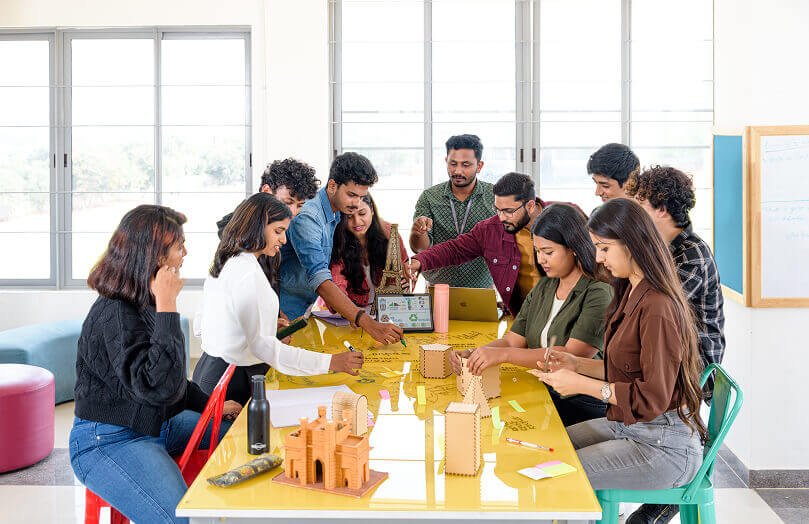
  2. The game development curriculum focuses on core practical subjects and trains students in Game Art, Game Creation, Board Games, 2D Production, 3D Production, and Visual Effects & Motion Graphics. The emphasis at CMR University is on experiential learning through practical experiments and projects. Various workshops and seminars are conducted for students to learn about current technology trends. Industry professionals guide students in analysing distinct art styles. In the final semester, students work on 2D and 3D model projects to apply core knowledge and showcase their game design skills.
  3. CMR University has the Office of Student Affairs (OSA), which provides students with resources, opportunities, and assistance through the Learning, Engagement & Advancement Programmes (LEAP). The university also has a student development and training program to support students with placement, internships, and competitive exams.

Programme Structure

Semester I
  • C++ Programming and Lab
  • Game Design 1
  • 2D Art for Games
  • Mathematics
  • Language
  • Common Core Courses
  • Community Service Programme – I 
Semester II
  • Data Structures and Lab
  • C# Programming and Lab
  • Game Design 2
  • 3D art for Game Environments
  • Interdisciplinary Elective I
  • Language
  • Common Core Courses
  • Community Service Programme – II 
Semester III
  • Artificial Intelligence
  • Game Development 1(Introduction to Unity)
  • Human Computer Interaction in Game Design
  • Interdisciplinary Elective II
  • Interactive Game System using Python
  • Common Core Courses
  • Community Service Programme – III 
Semester IV
  • Java Programming for Game Development and Lab
  • Game Development-2 (Advanced Concepts in Unity)
  • Game Psychology
  • MOOC Course
  • Interdisciplinary Elective III
  • Common Core Courses 
  • Career Preparedness Program-III 
Semester V
  • Virtual and Augmented Reality and Lab
  • Internship
  • Elective 1:
    • Integrating Online Services
    • Mobile Game Development
  • Game Development-3 (Introduction to Unreal using Blueprints)
  • Environment and Sustainability
  • Common Core Courses
Semester VI
  • Game Development – 4(Unreal Game Development using C++)
  • Indian Traditions: Values and Critical Inquiry
  • Elective 2:
    • Game Testing
    • Blockchain and Gaming
  • Capstone :2D/3D (Genre Based)

Programme Assessment

  • Choice-Based Credit System (CBCS): The university follows CBCS, allowing students to choose courses and earn credits based on their performance.
  • Grades and GPA: Students are awarded grades per course; SGPA and CGPA are calculated to assess academic performance.
  • Prescribed Curriculum: Includes required courses, labs, and MOOCs (SWAYAM).
  • Auditing Courses: Students may audit courses for additional exposure without earning grades.
  • Evaluation System: Evaluation consists of Continuous Internal Evaluation (CIE) and Semester End Examination (SEE), each carrying 50%.
  • Assessment Methods: May include assignments, presentations, seminars, industry reports, case studies, etc.
  • Semester End Examination (SEE): Conducted at the end of each semester unless exempted due to CIE coverage.
  • Makeup Examinations: Students who fail SEE are eligible for makeup exams, getting another opportunity to improve their grades.

Programme Outcome

  • Knowledge: Deep understanding of programming languages, game engines, app development tools, and the game development process.
  • Problem Solving: Identify and analyze complex problems and provide unique solutions tailored to each project.
  • Tools Usage: Use modern tools effectively for game and mobile application development.

  • Skill Set: Confidence in working on AAA PC, Console, and Mac-based games, multiplayer games, and AR/VR technologies.
  • Design and Development of Solutions: Understand the production pipeline and follow structured processes to reduce production issues and improve problem-solving efficiency.

Course Outcomes Visit

What Expertise will you gain?
  • Game programming languages such as C++ or C#
  • Computer graphics and rendering techniques
  • Game physics and simulations
  • Game design principles and mechanics
  • Game engine development and usage

Career Opportunities

  • 01
    Game developer
  • 02
    Game programmer
  • 03
    Game designer
  • 04
    Level designer
  • 05
    Game tester
  • 06
    Game artist

FAQs

Graduates can pursue careers in game and web development industries as Game Developers, Game Testers, Data Scientists, Android App Developers, and Software Engineers.

Yes. CMR University has a dedicated placement cell that organizes campus recruitment and prepares students with training programs. The university also facilitates internships and capstone projects.

Candidates should have knowledge of programming languages, UI/UX design, web development, strong communication and presentation skills, and a foundation in mathematics.

No, but Mathematics is compulsory. A basic knowledge of math helps in logical thinking and programming.

Three years.

Admission is based on a written test and interview.

Yes.

Yes, the program includes practical training and internships as part of the curriculum.

ACCP AY(2025-26)