

4 years
Full-time
Rs.1,37,500/- per semester
Candidate should have passed the 2nd PUC/12th/Equivalent Exam with a minimum of 45% of marks in Physics and Mathematics along with Chemistry/ Computer Science/Electronics/Information Technology/ Biology/ Informatics Practices/ Biotechnology/ Technical Vocational subject/ Agriculture/ Engineering Graphics/ Business Studies/ Entrepreneurship. (40% for Karnataka reserved category candidates) from a recognized board. Candidates must also qualify in one of the following entrance exams: CET/ COMED-K/JEE/Other state entrance tests /National level entrance test.
OR
Passed D.Voc. stream in the same or allied sector.
The B.Tech. programme in Information Technology (IT) is designed to meet the growing demands of the ever-evolving technological landscape. With a focus on equipping students with cutting-edge knowledge and skills, the curriculum is structured to prepare graduates for a successful career in the IT industry.
The best Information Technology colleges in Bangalore extend far beyond the confines of traditional software and hardware applications. Students delve into diverse areas such as software development, networking, web development, database management, and operating systems.
Furthermore, the programme goes beyond the basics, exposing students to emerging technologies like the Internet of Things (IoT), Cyber Forensics, Artificial Intelligence, and Biometric Management.
The programme empowers students to become proficient problem-solvers and technology experts who can adapt to the dynamic needs of the IT sector.
B.Tech. in Information Technology colleges in Bangalore offer a four-year curriculum with eight semesters. The college aims to foster a learning environment that encourages creativity, critical thinking, and innovation.
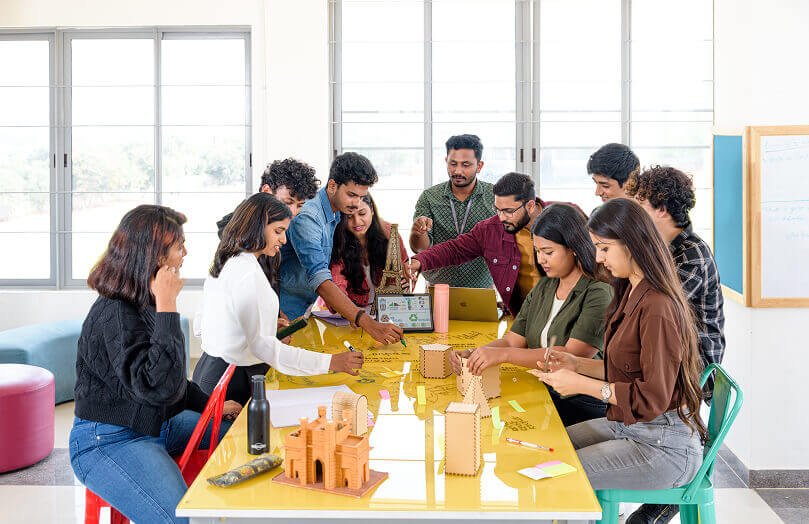
Through our unique Design Thinking and Experiential Learning pedagogies, students are encouraged to approach challenges from multiple angles and gain practical exposure to real-world scenarios.
Professional Electives
Elective I
Elective II
Open Elective I
Open Elective II
Professional Elective III & IV





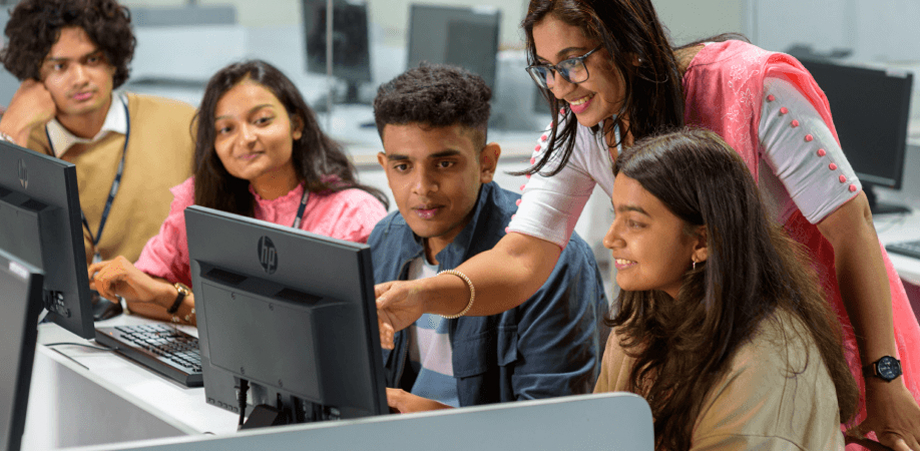
Step 1 – Application Enquiry
On-call guidance with step-by-step expert instruction on how to complete the application form.
Step 2 – Selection Process
Candidates are shortlisted after completion of document verification, interview & the CMRUAT entrance exam.
Step 3 – Offer Letter
Provision of Offer Letter to commence further process.
 Rs.1,75,000/- Per semester
  Undergraduate
  4 years
  Lakeside Campus
  Rs. 2,00,000/- Per semester Undergraduate 4 years Lakeside Campus
  Rs.1,75,000/- Per semester Undergraduate 4 years Lakeside Campus
  Rs. 1,37,500/- Per semester Undergraduate 4 years Lakeside Campus
  Rs.137,500/- Per semester Undergraduate 4 years Lakeside Campus
  Rs. 1,37,500/- Per semester Undergraduate 4 years Lakeside Campus
  50,000/- Per semester Postgraduate 2 years Lakeside
  55,000/- Per semester Postgraduate 2 years Lakeside
 Four years
Written test and interview
10+2 with physics, chemistry, and mathematics as subjects and a minimum of 45% marks in 10+2. Other equivalent qualifications may also be considered.
Yes, the BTech course at CMR University provides students with practical training and internship opportunities as part of the curriculum.
Computer engineering focuses on the hardware and software development of the system, whereas Information Technology keeps the systems that were built by somebody else running. When it comes to degree comparison, a Computer engineering degree is more hard-earned than an Information Technology degree. In CE, you will learn about the different OS, database management, programming languages, etc. Information Technology mostly covers networking and a few specializations overlapping CE.
Information Technology has seen a paradigm shift in recent years, especially with the move of the world toward a digital era. The demand for IT professionals is seeing an upward trend. There are several specializations available under Information Technology. A few of them are enlisted below:
The syllabus of BTech IT is vast, covering a plethora of subjects. It is equipped to give the students a theoretical as well as a practical outlook on the ever-growing industry demands of the career. The bachelor’s degree course is generally for four years, but you can extend it upto six years. It is used to study computer-based systems and further probe into the hardware and software systems of the computer.
IT courses can be pursued either as a diploma, undergraduate or a post-graduate course or all together. The courses give a vast spectrum of knowledge on how to solve problems in real-time via computer applications. IT is in demand and secures a high paying jobs in the top companies. Upon the completion of the course, you can work as a junior programmer, web developer, system administrator or system engineer.
There are many types of IT courses available to the pursuant. They include Java programming, core concepts of database management systems, algorithm analysis, information security, ERP, e-commerce, computer networking, cloud computing, software engineering and several different operating systems-related subjects. The courses offered are as follows: