CMR University has proudly secured Rank No. 9 in India in the Most Improved General University category and Rank No. 43 in India in the India's Best Universities category in the India Today Magazine – August 2026 Issue.
Important Update for Ph.D. Applicants and Research Scholars: The entrance and coursework examinations scheduled on 24th and 25th July 2026 have been rescheduled to 31st July and 1st August 2026 respectively.
Candidate should have passed the 2nd PUC/12th/Equivalent Exam with a minimum of 45% of marks in Physics and Mathematics along with Chemistry/ Computer Science/Electronics/Information Technology/ Biology/ Informatics Practices/ Biotechnology/ Technical Vocational subject/ Agriculture/ Engineering Graphics/ Business Studies/ Entrepreneurship. (40% for Karnataka reserved category candidates) from a recognized board. Candidates must also qualify in one of the following entrance exams: CET/ COMED-K/JEE/Other state entrance tests /National level entrance test.
OR
Passed D.Voc. stream in the same or allied sector.
Scope & Objectives
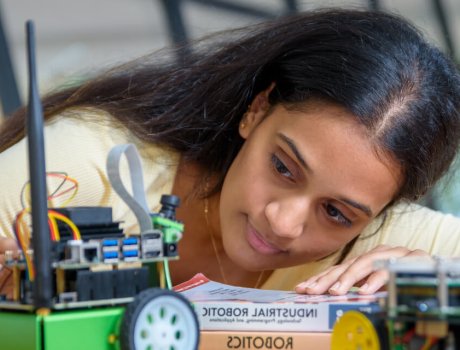
Electronics and Communication Engineering is one of the most sought-after fields in engineering, applying science and mathematics to solve practical problems. This field involves designing, developing, testing, and maintaining electronic and communication equipment.
If you’re passionate about gadgets and electronic systems, this programme is the right choice. You will learn concepts such as electronic devices and circuits, digital communication, and circuit analysis.
The programme provides a strong foundation in Mathematics, Physics, and Electronics, preparing students to supervise and manufacture electronic equipment. Students also gain in-depth knowledge of the principles of electronic devices and communication systems.
Programme Structure
Semester (Physics Cycle) I / II
Mathematics
Physics
Elements of Electrical Engineering
Elements of Civil Engineering
CAED
Common Core
Semester (Chemistry Cycle) I / II
Mathematics
Chemistry
Elements of Electrical Engineering
Elements of Mechanical & Workshop
Elements of Computer Engineering
Problem Solving Using Programming
Common Core
Semester III
Mathematics
Analogue System Design
Digital System Design
Network Analysis
Python (P2)
Common Core
Semester IV
Mathematics
Principles of Communication
Embedded Controller
VLSI
Python/C++/Java (P3)
Common Core
Semester V
Analogue and Digital Signal Processing
Embedded System and ARM Processor
Control System
Open Elective
Professional Elective I
Interdisciplinary Elective I
Common Core
Semester VI
Computer Communication Networks
Advanced Communication
Professional Elective II
Open Elective II
Interdisciplinary Elective II
Common Core
Semester VII
LTE and 5G Communication
Digital Image Processing
IoT and Applications
Professional Elective III
Professional Elective IV
Interdisciplinary Elective III
Common Core
Semester VIII
Project Work
Industrial Internship
Professional Elective I
Real-Time Embedded System and Linux
Sensors and Robotics
Automotive Electronics
Digital VLSI Design
ASIC
Nano Electronics
Optical Communication
Wireless Sensor Networks & IoT
Satellite Communication
Microwave and Antenna
Advanced C++ (P4)
Advanced Java (P4)
Object-Oriented Analysis & Design
Scripting Languages
Professional Elective II
RTOS
CAN Protocol and Controller
Wearable Electronics
Low Power VLSI
CMOS Analog Design
System on Chip (SoC)
Spread Spectrum Communication
RADAR
Mobile Communication
C# and .NET
J2EE Technologies
Unix Programming
Mobile App Development
Professional Electives III & IV
Biomedical Electronics
Virtual Instrumentation
Advanced Control System
CMOS RF Design
Mixed Signal Design
VLSI Testing
Multimedia Communication
MIMO Communication
Vehicular Communication
Full Stack (P5)
JavaScript
Web App Development
Network Programming
Open Electives I
Measuring Instruments
Introduction to Digital Image Processing
Basics of Digital Communication
Open Electives II
Cellular Communication
Basics of Satellite Communication
Basics of Embedded Systems
Programme Assessment
Choice-Based Credit System (CBCS): Allows students to select courses and earn credits based on performance.
Grades and GPA: SGPA is calculated per semester, while CGPA evaluates overall performance.
Prescribed Curriculum: Includes required coursework, labs, and MOOCs (SWAYAM), as approved by the university.
Auditing Courses: Students can audit non-graded courses for additional learning.
Evaluation System: Comprises Continuous Internal Evaluation (CIE) and Semester End Examination (SEE), each with 50% weightage.
Assessment Methods: May include assignments, seminars, quizzes, case studies, industry reports, etc.
Makeup Examinations: Offered for failed courses in SEE.
Programme Outcomes
Engineering Knowledge: Apply knowledge of mathematics, science, and engineering to solve complex problems.
Design/Development of Solutions: Design systems that consider societal and environmental factors.
Investigations: Conduct research using scientific methods and tools.
Modern Tool Usage: Employ modern IT tools with awareness of limitations.
Engineer and Society: Understand the social and ethical impact of engineering.
Environment & Sustainability: Demonstrate awareness of sustainable development.
Ethics: Follow ethical and professional responsibilities.
Individual & Team Work: Operate effectively both independently and in teams.
Communication: Write reports, make presentations, and communicate clearly.
Project Management & Finance: Apply engineering and management principles in practice.
Life–long Learning: Stay updated and continuously learn in response to technological changes.
10+2 with Physics, Chemistry, and Mathematics and at least 45% marks. Equivalent qualifications may also be considered.
Interest in signals, circuits, and communication systems. Problem-solving skills and some knowledge of programming and electronics are helpful.
ECE is the backbone of modern communication systems and internet applications. Students explore areas like VLSI, embedded systems, and wireless communication.
ECE graduates find careers in both private and public sectors, especially in telecom, hardware, and embedded systems roles.
Yes. The course includes practical training and internships as part of the curriculum.
Yes. CMRU has a dedicated placement cell offering interview training and placement support. Recruiters include:
Atos Global IT Solutions
Deloitte
Infosys
Amazon
HCL Technologies
Goldman Sachs
IBM
Flipkart
Excellent lab facilities, experiential learning, design thinking pedagogy, and experienced faculty with expertise in VLSI, IoT, and signal processing.
This website uses cookies to improve your experience while you navigate through the website. Out of these cookies, the cookies that are categorized as necessary are stored on your browser as they are essential for the working of basic functionalities of the website. We also use third-party cookies that help us analyze and understand how you use this website. These cookies will be stored in your browser only with your consent. You also have the option to opt-out of these cookies. But opting out of some of these cookies may have an effect on your browsing experience.
Necessary cookies are absolutely essential for the website to function properly. This category only includes cookies that ensures basic functionalities and security features of the website. These cookies do not store any personal information.
Any cookies that may not be particularly necessary for the website to function and is used specifically to collect user personal data via analytics, ads, other embedded contents are termed as non-necessary cookies. It is mandatory to procure user consent prior to running these cookies on your website.