
Innovation has moved forward by leaps and bounds over the last century. At CMR University’s School of Engineering and Technology, build your path through our engineering and technology programmes in this ever-evolving field.
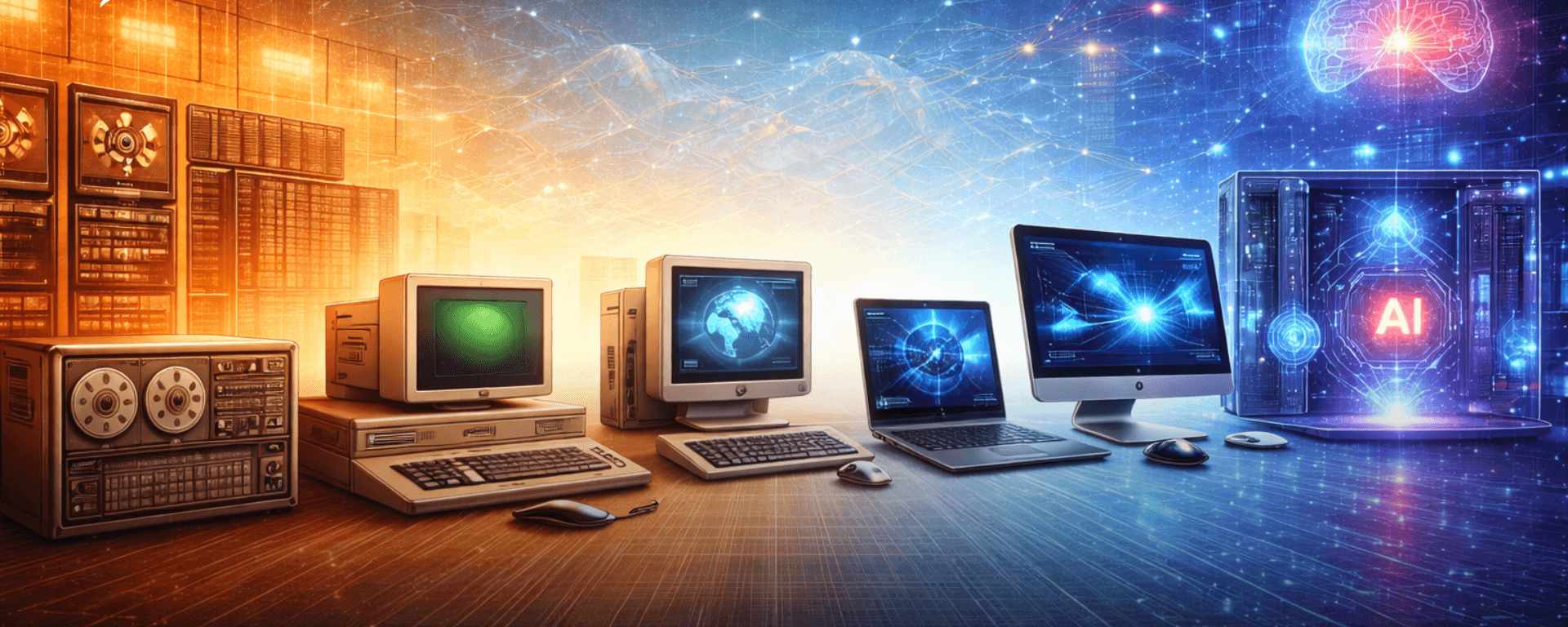
Curious to know how we moved from giant computers that once filled entire rooms to the AI-powered world we now live in? Read on to learn about the history of computer generations.
How computers changed the world
Imagine a world without smartphones, the internet, or cloud storage. Almost impossible, right? From our photos and banking to our studies and work, technology quietly runs our lives. But it wasn’t always like this. The first computers were so large that they filled entire rooms and weighed over 27 metric tonnes. They were slow, expensive, and built for very specific tasks. Still, they laid the foundation for the devices we use today.
The 5 generations
On the basis of advancements in hardware and software, the evolution of computers can be divided into five distinct phases, each called a generation. Every generation reflects improvements in processing power, efficiency, size, and overall capability. With each step forward, computers became more powerful, more reliable, and more accessible. What started as machines for scientists and the military slowly became tools for businesses, then households, and now individuals.
1. First generation (1940s to 1950s): Vacuum tubes
The early development of computers began in the 1940s, when vacuum tubes were the main mechanism through which these machines functioned. A vacuum tube, also known as an electron tube or valve, is a glass device that controls the flow of electrical current in a sealed enclosure where most of the air has been removed. By applying electrical signals to different parts of the tube, called electrodes, the flow of electrons can be controlled. In first-generation computers, vacuum tubes acted as switches that allowed calculations to happen.
These computers were huge, fragile, and generated a lot of heat. They also consumed large amounts of electricity and needed constant maintenance. Programming them was complicated because instructions were written in machine language.
One of the earliest computers was ENIAC, short for Electronic Numerical Integrator and Computer. Built in 1943 at the University of Pennsylvania, it weighed nearly 30 tonnes and used more than 18,000 vacuum tubes. It was mainly designed for military calculations. Even though it sounds primitive today, it was revolutionary at the time because it showed that electronic computers could work on a large scale.
Another milestone was UNIVAC, the first commercially sold computer, completed in 1951. It was smaller than ENIAC and used fewer vacuum tubes, but it still required significant space. UNIVAC marked the beginning of computers being used in business and government work, especially for handling data and records.
2. Second generation (Late 1950s to 1960s): Transistors
The second generation replaced vacuum tubes with transistors. This single change made a huge difference. Transistors were smaller, faster, cheaper, and far more energy-efficient. They also produced less heat and failed less often.
Because of this, computers became more reliable and more practical. They were mainly used in scientific research, engineering, and business operations. This period also saw a shift from machine language to higher-level programming languages like FORTRAN and COBOL. These languages made programming more structured and easier to learn, which meant more people could work with computers.
Computers were still large and expensive, but they were clearly becoming useful tools rather than experimental machines. Businesses started depending on them for payroll, accounting, and data processing.
3. Third generation (Mid-1960s to 1971): Integrated circuits
The third generation introduced Integrated Circuits, or ICs. These small chips combined multiple electronic components into one compact unit. Instead of wiring many separate parts together, engineers could now place them on a single chip. This made computers smaller, faster, and more dependable.
Processing speeds improved significantly, moving from microseconds to nanoseconds. Storage capacity also increased with magnetic disks and tapes. Computers could now handle more data and more complex instructions.
Another important change was how people interacted with computers. Keyboards and monitors slowly replaced punch cards. Operating systems also improved, allowing multiple programs to run at the same time. Computers were still mostly used by organisations, but they were becoming easier to operate.
4. Fourth generation (1970s onwards): Microprocessors
The fourth generation began with the invention of the microprocessor. A microprocessor fits thousands, and later millions, of transistors onto a single chip using Very Large Scale Integration technology. This allowed computers to become much smaller and much more affordable.
The development of the microprocessor led to personal computers. Suddenly, computers were not just for large institutions. Offices, schools, and eventually homes could own them. This changed how people worked, learned, and communicated.
Companies like Intel played a major role in developing microprocessors that powered early personal computers. As software improved and graphical interfaces appeared, computers became more user-friendly. By the end of this period, computers were part of everyday life for many people.
5. Fifth generation (Present and beyond): Artificial Intelligence
If you have been online recently, you have probably seen AI videos, AI trends, or even AI influencers. The fifth generation is defined by artificial intelligence, machine learning, and advanced computing. These technologies allow computers to learn from data, recognise patterns, and make decisions.
AI is already part of daily life. Writing tools like Grammarly help proofread content. Smart assistants can set alarms, answer questions, and control devices at home. Creative platforms like Midjourney generate images from text prompts and are widely used by artists and designers. AI is also used in healthcare, education, banking, and transport.
At the same time, AI has raised several concerns.
- Energy consumption
Training and running AI models require powerful data centres. These use large amounts of electricity and water, which can increase carbon emissions and pressure natural resources. - Job losses due to automation
You have probably heard people say AI takes away jobs. If AI can design graphics or write articles quickly, some roles may shrink. While new jobs also appear, the transition can be difficult. - Overreliance and loss of human judgement
Because AI makes tasks simple, people can become too dependent on it. Some even share personal problems with AI tools as if they were therapists, forgetting that AI lacks real empathy and human understanding. - Privacy and data misuse
AI tools learn from huge amounts of data, often including personal information. When protections are weak or policies are unclear, private data can be used in ways people never fully agreed to, sometimes without them realising.
Trends and the future
The rapid progress of technology has already granted us many useful tools, and a new wave of innovations is now taking shape, with several trends quietly gaining traction and expected to make a significant impact on our lives. From smarter AI to more efficient and practical systems, these shifts are set to influence how we work and live.
- 6G
6G is expected to be a future network where AI helps manage and optimise the network itself. This could make connections faster, smarter, and more efficient than 5G. - Agentic AI
Agentic AI refers to systems that can plan, act, and make decisions on their own with minimal human input. - Physical AI
Physical AI connects intelligence to the real world. Self-driving cars and advanced robots are early examples. These systems sense their surroundings and respond in real time. - Small Language Models
Small Language Models use less memory and computing power than large models. They can run on phones or offline systems. They are usually better for specific tasks rather than broad ones, but they are faster and cheaper.
Shaping the future
From computers that filled entire rooms to phones that fit in our pockets and answer questions in seconds, technology has come a long way. It has changed how we study, work, communicate, and even relax.
Innovations like agentic AI and 6G are not just technical upgrades. They influence how people think, interact, and create. As technology grows smarter, the responsibility on humans grows too. We need to use it wisely and remember that human judgement, empathy, and creativity cannot be replaced.
The evolution of IT is not only about machines becoming smaller or faster. It is about how these tools improve everyday life and open new possibilities. Technology shapes the future, but people decide how it is used. And that is what truly determines where we go next.