cmr.edu.in CMR University Pedagogy | Learning, Design Thinking & Practice

Pedagogy

Education for a
World in Motion

At CMR University, academics go beyond traditional instruction. Our programmes are designed to spark curiosity, foster creativity, and build the confidence to think critically and act independently. In an increasingly complex world, we believe that education must evolve to prepare students not just for jobs, but for life.
The academic framework at CMR University is rooted in interdisciplinarity, flexibility, and relevance. We offer modular, multi, inter, and cross-disciplinary programmes that reflect emerging trends and future-ready skills. Courses are structured to encourage exploration across domains while building deep expertise in chosen fields.

Core to our curriculum is a strong focus on design thinking, innovation, and sustainability, integrated across disciplines to equip students to solve real-world challenges with empathy and insight. From business to engineering, law to psychology, every programme is designed to nurture problem-solvers, leaders, and change-makers.

We believe that the most powerful learning happens through doing. Inspired by the maxim, “I listen, I forget. I see, I remember. I do, I understand,” our pedagogy emphasises experiential learning through hands-on projects, simulations, workshops, and industry collaborations.

Learn. Think.
Do. Become.

Collaborative
Learning

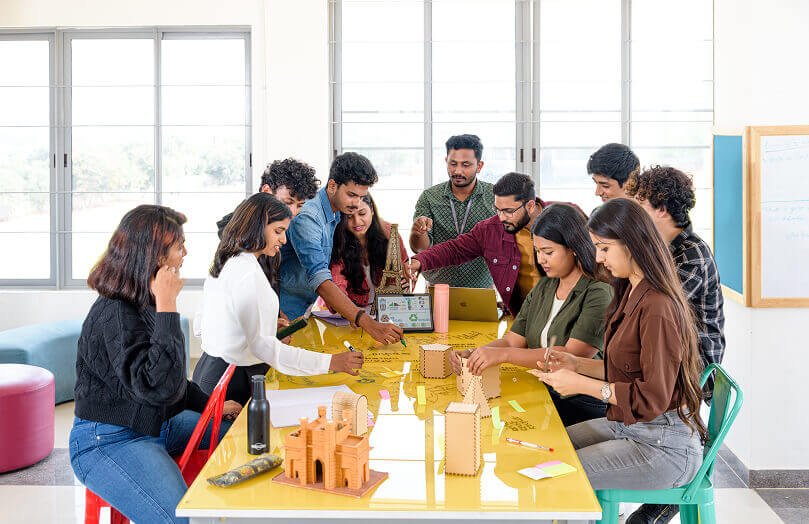
At CMRU, learning is not a solitary pursuit. It thrives in collaboration. Students engage in peer-to-peer learning, team-based assignments, and interdisciplinary problem-solving that mirror real-world work environments.

Our Continuous and Comprehensive Evaluation (CCE) system ensures that assessments reflect not just academic mastery but also contribution to group work, participation in class activities, and practical application of concepts. This holistic approach promotes deeper understanding, confidence, and growth.

Design Thinking Approach

At CMR University, Design Thinking is integrated across all academic programmes to foster a culture of innovation, empathy and purposeful problem-solving. This approach encourages students to think critically and creatively while developing strong collaborative skills that are essential in today’s dynamic professional landscape.

By emphasising user-centric and interdisciplinary learning, Design Thinking prepares students to address complex, real-world challenges with clarity and confidence. It also enhances graduate employability by building adaptability, resilience and the ability to create meaningful, socially relevant solutions.

Interdisciplinary Approach

CMR University adopts an interdisciplinary approach across all programmes, enabling students to develop a holistic understanding of complex issues that extend beyond traditional academic boundaries. By synthesising knowledge from diverse fields, students build critical thinking, adaptability and innovative problem-solving skills. This interdisciplinary outlook prepares graduates to navigate an increasingly interconnected world. It strengthens their ability to collaborate across disciplines and industries, significantly enhancing their professional versatility and long-term employability.

Community Service

At CMR University, community service is integrated into every academic programme, instilling social responsibility and civic engagement in students. Through meaningful, hands-on experiences, students engage with real-world challenges, developing empathy, critical thinking and problem-solving skills.

This experiential approach strengthens personal growth, builds leadership abilities and broadens professional networks. It nurtures well-rounded graduates who are socially conscious, ethically grounded and committed to making a positive impact on their communities and society at large.

MOOCs &
Certification Courses

Massive Open Online Courses (MOOCs) are digital platforms that provide high-quality, university-level learning to students across the world. At CMR University, MOOCs and professional certification courses are integrated into the curriculum to give students access to specialised, up-to-date knowledge that complements their academic programmes.

Through partnerships with global institutions and industry leaders, students explore emerging areas such as artificial intelligence, digital marketing, data analytics and entrepreneurship. These courses promote flexible, self-paced learning and allow students to deepen their expertise in fields that may extend beyond traditional classroom instruction.

This integration strengthens students’ academic and professional profiles by offering industry-relevant knowledge, recognised certifications and valuable credentials. It also nurtures habits of continuous learning, critical thinking and professional growth. By earning certifications alongside their degrees, CMR University students enhance their employability and broaden their opportunities in an increasingly competitive and dynamic job market.

NEW AGE APPROACH

Holistic growth of students

At CMR University, a new-age approach to holistic student growth extends well beyond academic learning. It focuses on nurturing the whole individual intellectually, emotionally, socially, physically and ethically, ensuring that students develop as well-rounded, future-ready graduates.

This model strengthens critical thinking, creativity and adaptability, while also building essential life skills such as emotional intelligence, resilience, collaboration and problem-solving. By placing equal emphasis on well-being, purpose and community, the university fosters a strong sense of belonging and self-awareness among students.

Through diverse, hands-on and interdisciplinary learning experiences, including real-world projects, community engagement and experiential coursework. Students are equipped to navigate complex challenges, lead with empathy and contribute meaningfully to society. This holistic approach prepares them not only for successful careers, but for fulfilling, impactful lives.

Curriculum Highlights

Student-Centred Pedagogy

Inquiry-based and experiential learning models

  • Outcome-based education (OBE)
  • Personalized academic pathways with faculty mentoring
Global Exposure
  • International academic collaborations (MoUs, dual degrees, student exchange)
  • Guest lectures and joint projects with global universities
  • Study abroad, international internships, and cultural immersion programs
Innovation-Driven
Curriculum
  • Interdisciplinary programs combining technology, business, and liberal arts
  • Continuous curriculum updates aligned with industry and global trends
  • Integration of emerging technologies: AI, sustainability, data science, design thinking
Holistic Development
  • Smart classrooms, advanced laboratories, and simulation centers
  • Maker spaces, incubation labs, and the CMR Innovation Centre
  • Access to digital platforms and global research databases
Research-Led
Teaching
  • Faculty engaged in funded research and publications
  • Student research fellowships and paper presentations at national/international forums
  • Centres of Excellence in AI, Law & Society, Sustainable Design, etc.
Cutting-Edge
Learning Environment
  • Smart classrooms, advanced laboratories, and simulation centers
  • Maker spaces, incubation labs, and the CMR Innovation Centre
  • Access to digital platforms and global research databases

Three Pillars of
Curriculum
at CMRU

01

Preparing for
Success

This pillar is built around equipping students with the essential skills, mindset, and tools for long-term success in both careers and life. At CMR University, we recognise that success today requires more than academic achievement, it demands communication skills, digital fluency, adaptability, and critical thinking.

Courses such as Design Thinking, Oral and Written Communication, Business Management for Engineers, and Internship Preparedness are embedded in the curriculum to help students make a smooth transition into professional life. This approach strengthens career resilience and nurtures habits of lifelong learning. Students gain the confidence to respond to emerging global challenges, seize opportunities, and shape their own professional journeys.

The pillar ensures that graduates are future-ready, self-assured, and empowered to contribute meaningfully to their workplaces and wider communities, wherever they choose to go.

02

Knowing Self
& Community

This pillar emphasises self-awareness, emotional intelligence, and social consciousness, vital qualities for inclusive leadership and ethical engagement. At CMR University, students are encouraged to reflect on their identity, beliefs, values, and cultural contexts. Courses such as Indian Constitution and Social Change, Ethics and Values, and Environment and Sustainability empower learners to connect their academic experiences with real-world social concerns.

The curriculum fosters understanding of diverse perspectives and encourages open, respectful dialogue. By cultivating a deep awareness of the self and society, students become grounded individuals capable of thoughtful action. They are better prepared to collaborate across boundaries, respond with empathy, and uphold equity in everything they do. This pillar ensures students develop the moral compass and reflective capacity to contribute with responsibility and integrity in a rapidly changing world.

03

Contributing
to Society

This pillar reflects CMR University’s commitment to creating socially engaged leaders who drive change through action, service, and innovation. It supports the belief that education should benefit not only the individual but also the wider world.
Courses such as Community Service, Sociology of Globalisation, and Sustainable Development,  combined with hands-on social impact projects, offer students opportunities to understand and address complex societal challenges. Through these experiences, students develop leadership grounded in empathy and purpose. They learn to apply their knowledge to create positive change, whether in urban communities, rural initiatives, or global causes.

This pillar fosters a deep sense of civic responsibility, encouraging students to become active participants in society. Graduates leave with a clear purpose: to contribute meaningfully, solve real problems, and lead with vision and compassion.Ultimately, students are inspired to see themselves not just as learners, but as change-makers in the world around them.

ACCP AY(2025-26)